Tuesday, April 15, 2014

A Visit to Bill's Birthplace in Hope Arkansas


Just before midnight Mountain Standard Time on November 3, 1992, I was laying in my bed in the Doubletree Hotel on Union Boulevard in Denver when news was flashed on the television screen announcing that Bill Clinton had become the 42nd President of the United States.  I leaped out of bed and danced around my room, screaming and hollering.  I opened two bottles of beer, shook them, and then sprayed them all over the room! 

Soon there was a knock on my door and on opening it I found hotel security standing there with a rather stern look on his face.  Asking me what was going on I told him “Bill was elected!!! Twelve years of tyranny against the earth is now officially over!!!”  The security guard smiled and said “I’m excited too but just try to hold it down a bit will you?”


Bill Clinton's first white house was this tiny one in Hope Arkansas

Bill Clinton was born in a tiny house near the intersection of two major roads (for Hope Arkansas at least they are major) by the railroad tracks in Hope Arkansas.  From those humble beginnings he moved to Hot Springs, Arkansas about 90 minutes away where he attended and graduated from high school.  After college and a Rhodes scholarship at Oxford and then Yale Law school he taught at the University of Arkansas, got into politics, was elected Governor of Arkansas four times, then elected President of the United States, and left office on one of the saddest days of my life. 


While Bill was in office he enjoyed some major accomplishments summarized by the National Archives and Records Administration including these documentable facts:

Longest economic expansion in American history

Highest homeownership in American history

Lowest unemployment in 30 years

Raised education standards, increased school choice, and doubled education and training investment

Largest expansion of college opportunity since the GI Bill

Connected 95 percent of schools to the Internet

Lowest crime rate in 26 years

100,000 more police for our streets

Enacted most sweeping gun safety legislation in a generation

Family and Medical Leave Act for 20 million Americans

Smallest welfare rolls in 32 years

Higher incomes at all levels
Lowest poverty rate in 20 years

Lowest teen birth rate in 60 years

Lowest infant mortality rate in American history

Deactivated more than 1,700 nuclear warheads from the former Soviet Union

Protected millions of acres of American land

Converted the largest budget deficit in American history to the largest surplus

Lowest government spending in three decades

Lowest federal income tax burden in 35 years

More families own stock than ever before

Most diverse cabinet in American history

When Bill left office the nation 1) had a multi-billion dollar (>500 billion in fact) budget surplus, 2) had not been lied into a war with Iraq, and 3) was adored by 85 percent of the world’s population. Those are all things his predecessor could never claim.

Those accomplishments and his humble beginnings are memorialized at the President William Jefferson Clinton Birthplace Home National Historic Site in Hope, Arkansas.  This NHS, the 394th unit of the National Park Service system was the 393rd unit I have visited.

The National Historic Site consists of two buildings.  First the visitor center set in a brick building with a spacious back yard and next to it the small white house that was the first White House he lived in.  Dioramas and other educational materials in the visitor center tell the story of his life in Hope and in Hot Springs and his eventual movement through the ranks to be one of the best Presidents in the 20th Century. 

I visited the site on April 13, 2014, on a blustery Sunday morning with storm clouds hanging ominously in the western sky.  After obtaining my NPS passport stamp for the site I had a nice chat with the NPS employee working that morning who filled in a lot of missing bits of information I thought I had about Bill Clinton.  From the Visitor Center I followed a small path to the white house (not open for entry) and then hung out in the back yard trying to imagine him darting around being a typical little kid there. 

Because of the relative newness of the National Historic Site the amount of information about him is meager in comparison to most other NPS sites.  However there is a super abundance of information about him at the Clinton Presidential library along the Arkansas River in Little Rock.  I jokingly asked the NPS employee if Bill ever stops by his National Historic Site and was informed that he does not.  That is unfortunate because Jimmy Carter regularly shows up at his National Historic Site in Plains Georgia.  The NPS employee chuckled and said “He’s probably too busy out trying to save the rest of the world to stop by to see us.”


The Bill and Hillary Clinton National Airport in Little Rock, Arkansas is the only airport in America named after a former and a future United States President

After about 30 minutes at the National Historic Site I left Hope and made my way back to the Little Rock airport only 120 miles away.  On driving into the airport I noticed the large sign announcing its presence and on looking at it noted what I hope is an omen.  The Little Rock airport is named the “Bill and Hillary Clinton National Airport.”  That makes it the only airport in the United States named after a former and a future United States President.  That’s just more hope coming from Hope Arkansas.


Every American Should Visit Little Rock Central High School National Historic Site


The United States Supreme Court, in its landmark decision in Brown vs Board of Education in 1954 mandated that public schools in the country could not be segregated.  It all gets back to the “separate but equal” clause in the often-trampled Constitution.   Despite word from the Supremes that segregation was no longer to be tolerated, knuckle-dragging Arkansas Governor Orval Faubus decided (over the disagreement of the Little Rock School Board) that Little Rock Central High School would not be integrated after nine black students registered for classes there in 1957. 


When the nine black students attempted to enter Little Rock Central High School (which was their right according to the Supremes) Governor Faubus activated the National Guard and made them block the school entrance to keep the black students out.  An outraged President Dwight D. Eisenhower (the last real Republican to be President) Federalized the National Guard and suddenly those same guardsmen who were keeping the students out of the school were protecting them as they tried to enter.


An oft-forgotten amendment to the US Constitution

In a response reminiscent of the protesters at the Democratic Convention in Chicago chanting “The whole world’s watching” the entire world was focused on the events unfolding in Little Rock.  Arkansas became the epitome of state resistance when the governor, Orval Faubus, directly questioned the authority of the federal court system and the validity of desegregation. The crisis at Little Rock's Central High School was the first fundamental test of the national resolve to enforce black civil rights in the face of massive resistance during the years following the Brown decision. As to whether Eisenhower's specific actions to enforce integration violated the Posse Comitatus Act, the Supreme Court, in Cooper v. Aaron (1958), indirectly affirmed the legality of his conduct, which was never, though, expressly reviewed.

In 1958, federal Judge Jesse Smith Henley of the United States District Court for the Eastern District of Arkansas, stating that integration had "broken down under the pressure of public opinion," suspended operation of the federal integration order until the 1960-61 school term. The school board said that it had faced large fees and could not afford to hire security guards to keep the peace in school.


The words of one of the Little Rock Nine

Eventually Little Rock Central High School along with every other public school in the country was integrated and for the most part the plan continues to work.  The Congress established the Little Rock Central High School National Historic Site, located directly across the street from the actual high school, to memorialize that historically important event.  I visited the National Historic Site the first time on May 20, 2000, when the visitor center was in an old (now preserved) Mobil gas station across the street from the school.  I returned on April 11, 2014 to a much improved and expanded visitor center at the corner of 14th and Cumberland near downtown Little Rock.

In typical National Park Service fashion they have produced a superb site for educating the public about the events of those long ago days.  Several dioramas are in place telling stories of the Little Rock Nine, there is a constantly running news clip from the day Eisenhower Federalized the National Guard, and there are reminders all over the building of how horribly white people treated (and often today continue to treat) black people.


One of many photos available in the National Historic Site that tell the story of that horrible period in American history. Although this little Hitler youth's sentiment is largely overshadowed today it is unfortunately not behind us. Places like the Little Rock Central High School National Historic Site are excellent places to help bury that sentiment forever.

I spent about an hour at the National Historic Site before heading out to visit some National Wildlife Refuges in Arkansas.  As I departed I said to the person at the front desk that “everyone in this country needs to visit this site.”  And everyone in this country does.  

Perhaps if more people were slapped in the face with the reality of how black people were treated there wouldn’t be so much outward anger and hatred directed at folks who, just like white people, bleed red when our skin is cut.

Wednesday, April 9, 2014

The Unsportsmanlike Conduct of Jesus Montero of the Palm Beach Cardinals


Jesus Montero, the hot-headed catcher for the Palm Beach Cardinals in the Florida State League seems to have a little bit of an issue with not only plate discipline but also personal discipline.  The following is an email I sent today to the general manager of the Palm Beach Cardinals and to the President of the Florida State League regarding the unsportsmanlike conduct of Jesus.  I wanted to send it to the St. Louis Cardinals Director of Player Development but couldn't find his email address.  I sent it to him by snail mail instead.  I have now christened Jesus as "Peroito" - or "my little lap dog" and Sanguineo" which means "quick tempered" or "the hot head" for the remainder of his tenure in a Palm Beach Cardinals uniform.  Jesus is a very slow learner.

April 9, 2014


Dear General Manager of the Palm Beach Cardinals

In case you weren't aware before you have a little issue that needs to be dealt with on the roster of the Palm Beach Cardinals.  Jesus Montero, the Palm Beach Cardinals catcher is in need of a little counseling and perhaps a good ass chewing.

In a game with the Bradenton Marauders on August 14, 2013, Mr. Montero stopped his activities and gave me the finger essentially saying "fuck you" to me as I heckled him from behind home plate at McKechnie Field. My heckling of the opposition was no different than it was for any other visiting player.  

In reviewing notes on Palm Beach players before last night's April 8 2014 game between the Cardinals and Marauders I discovered a notation about Montero giving me the finger last year.  This led to immediate reminders of that incident each time Montero came to bat last night.  In the 6th inning of last night's game, after Montero made a mistake behind home plate, he turned around and mouthed the words "Fuck You" to me.   Then later, in the 9th inning when Montero was at bat he received more than the usual amount of attention from me and my colleague Dave Hilsheimer.  When Montero struck out and Hilsheimer did his now-famous march back to the dugout, Montero turned around and in front of the entire crowd gave us the finger again!  His actions were obvious enough that nearly the entire stadium responded when they saw him.  Not only does this reflect badly on Montero and demonstrate his lack of maturity, it also reflects negatively on the Palm Beach and St. Louis organizations.

Heckling is as much a part of the game as is throwing strikes or hitting a home run. And if players at this level (Advanced A) can't handle a little verbal distraction by two retirees in the stands behind home plate, they will never survive a place like the stadiums and fans in Philadelphia or New York.  Montero's repeated use of giving opposing fans the finger on top of him openly and obviously mouthing the words "fuck you" to a fan he doesn't like suggests to me that he is not mature enough to be allowed on a professional baseballl field.  

What is Montero going to do with the next fan he doesn't like?  Will the Palm Beach Cardinals pay for his legal defense if he comes off the field and shoves a knife into a fan who pestered him?  We live in a state where everyone and their brother carries a gun and where shooting someone and claiming you were standing your ground is almost an art form. What will the Cardinals do if this little hot head shoots someone who pesters him between innings?

For me personally I love the fact that Mr. Montero is so easily flummoxed on the field and if he thinks giving fans the finger is going to stop us from heckling he is completely misinformed.  In fact Montero's actions last night only served to earn him more unwanted attention and at a louder, more personal level.  Bottom line from this, however, is that the Palm Beach Cardinals and the St Louis Cardinals organization have a walking powder keg on their hands with Mr. Montero. If you take no action on reprimanding Montero for his unsportsmanlike behavior and he ultimately harms a fan he doesn't like, then both Palm Beach and St. Louis can never say "we had no idea" because now you do.

I wanted to include the St. Louis Cardinals director of player development on this email but couldn't find his email address.  I will copy the email and mail it to him instead.

Craig Faanes

Monday, April 7, 2014

Why Isn't Earth Day a National Holiday?


Earth Day is Tuesday April 22. On the first Earth Day in 1970 the Cuyahoga River was on fire as it flowed through downtown Cleveland on its way to Lake Erie. 

The cornucopia of unregulated pollutants being dumped into the Cuyahoga River at Cleveland caused the river to burn as it flowed into Lake Erie 

Today after passage of the Water Pollution Control Act aka Clean Water Act and other protections we have salmon spawning in the Cuyahoga River in downtown Cleveland.


The Cuyahoga River near downtown Cleveland today looks like it belongs in the wilds of northern Wisconsin - and it has lake-run salmon spawning in it each spring


Protection of Mother Earth is celebrated one day each year (shouldn't we celebrate our real mother everyday?) in April. Given the importance of clean water to drink and clean air to breathe and wild areas to get in touch with ourselves again I think Earth Day should be a National holiday. Columbus Day is and Chris never stepped foot on what is now the United States.


Shouldn't the giver of all life - the Earth - rank higher in priority than an Italian sailor who was looking for spices for the King and Queen of Spain when he landed on Grand Turk island in the West Indies?

Sunday, April 6, 2014

When Rice Lake Beat Montello in Chicken Judging


The Rice Lake (Wisconsin) Future Farmers of America program was a powerhouse among Wisconsin chapters in the late 1960s.  This was due in whole and in part to Donald Triebensee our teacher and chapter advisor.  Don was a great teacher and a great man on top of being a great inspiration to many.  He always strived for excellence in his students even when some of us (like me) were major league goof offs.


One of the things Don had us actively involved with was the various statewide judging contests.  We kicked ass and took no prisoners when it came to Meat Animal Judging (beef cattle, sheep, swine) (State Champions in 1968), and Dairy Cattle Judging (State Champions in 1968) on the University of Wisconsin Madison campus. There was some other contest we won on the University of Wisconsin – River Falls campus. A couple years later it would have been a beer drinking contest but right now I can’t remember now what it was.  For some unexplained reason we simply could not get it when it came to Soil Judging (last place 1968, 1969) but give us a living breathing animal and we’d correctly judge it 99 times out of 99.


Forty five years ago this month, April 1969, just a few weeks before the Rice Lake Senior High School Class of 1969 was unleashed on an unsuspecting world (our unofficial class motto was “Booze, Broads, Butts, Wine – We’re the Class of Sixty NINE!”) the Wisconsin FFA association held its annual Poultry and Egg judging contest on the campus of the incomparable University of Wisconsin campus in Madison.  Rice Lake had participated in this judging contest in the past but had never fared well.  In those days Montello High School in Marquette County (north northeast of Madison) always won the Poultry and Egg contest – nobody ever came close. Still that did not dissuade Don Triebensee from putting together a team and giving it a shot.

The 1969 team was made up of three seniors and on Thursday before the contest the following Monday (four days earlier) it was determined that two of them could not make the trip (for whatever reason I cannot remember now).  That left one senior on the team and two others were desperately needed or Rice Lake would not field a team.


For whatever reason with just a couple days to go before the contest, Don Triebensee almost begged FFA Chapter President Dave Bollman and me to be on the team.  At the time about all I knew of chickens was that 1) everything tastes like them including chicken, 2) they get run over while trying to cross to the other side of a road, and 3) my mom could burn eggs while frying them almost as easily as she could burn everything else.  However Mr. Triebensee was desperate and I couldn’t turn him down so I said yes.  If nothing else we would get a free trip down to Madison where we could ogle college girls recently emerged from a winter of long pants, sweaters, and over coats as they sunned themselves on the shores of Lake Mendota. 


With little time and even less chance of winning, Mr. Triebensee gave us several books to read and said he had made arrangements with the Uchytil Egg Farm in Haugen to teach us what they could about chickens and eggs.  By this stage in our lives, we were far from proficient at feeling up girls in the Class of 1969 but that didn't stop us from wanting to learn how to feel up a chicken or how to candle an egg to determine its quality.  Uchytil’s had offered to give us that essential training and we were to be at the egg farm at 9:00 a.m. on Saturday morning.  The three of us spent almost all day Saturday at Uchytil’s learning the ins and outs of chicken feeling up. 


Among other essentials we learned that if you could place three fingers in the space between the pubic bone of a chicken then they were in prime egg laying condition (life later taught us that it worked that way with human females also but we didn’t know that then).  If only one or two fingers fit in the pubic bone socket then she was not in good condition.


We learned how to tell the health of a chicken by feeling for its breast bone (another technique readily and eagerly transferable to the girls in the Class of 1969).  If the breast bone stuck out above the level of the breast meat then the chicken was undernourished and not in good condition.  However if you felt her breast and there was lots of flesh there and little bone then she was in great shape (I tried that technique later that night on a girl in our class and was amazed how similar were the results).

We also learned how to candle an egg.  Place an egg with the small end against a light source and judge how much air space existed in the end of the egg.  If there was very little airspace then the egg was fresh and of good quality.  If a lot of airspace was present then the egg and its quality were questionable and that egg would get a lower ranking.  We later tried to figure out how to transfer this bit of knowledge to the girls in the Class of 1969 but never made the connection.  However we were ready if the opportunity arose.


A candled egg showing the airspace

After spending a full day in a crash course in Chicken Feeling Up 101 at Uchytil’s farm in Haugen we returned home, milked cows, packed our bags and prepared ourselves for the four hour drive the next day down to Madison.

A trip to Madison was a major thing in those days.  A year previously, on the same weekend that Martin Luther King was assassinated, we were in Madison for the State Meat Animal judging contest.  The most memorable thing about that trip was watching Greg Rindsig, who was as skinny as a rail, wolf down 7 McDonald’s cheeseburgers, 4 packets of McDonald’s French fries, and 3 McDonald’s chocolate shakes in one setting in a Mickey D’s on US 151 on the east side of Madison.  Greg wasn’t with us in 1969 since he graduated the year before so we just relied on ogling college girls sunbathing on the lake shore.

Monday morning dawned crystal clear on the campus of the venerable University of Wisconsin (“Fuck em Bucky!”).  Mr Triebensee took us out to Camp Randall Stadium after breakfast just to look around.  Camp Randall is where the Badgers play football. It is the second most hallowed ground in the entire Cheesehead State – only Lambeau Field where the Packers play in Green Bay is held in higher reverence among Cheeseheads than is Camp Randall Stadium.


Bucky on the hallowed ground of Camp Randall Stadium

After an invigorating visit to the cathedral known as Camp Randall, and with one entire day of knowledge of chicken feeling up under our belts, we three intrepid seniors showed up on the College of Agriculture of the Madison campus where we did battle with the chicken goliath’s from Montello and 28 other high schools.  Team members were separated from each other and despite each participant feeling up the same chickens, no team members were allowed to be near the same chicken at the same time, ostensibly, I guess to reduce the chance for passing notes on chicken tits and their fullness to team members.  The same was true for the eggs we candled – we were in this alone. 

At the end of the contest the total scores for each team member were tallied and a cumulative score was awarded to each of the 30 teams involved in the contest.  As we waited for the judges to make their determinations we anticipated just how badly Montello had wiped the floor with us and everyone else.

However that was not the story today.  Nope.  When all the score cards were graded and all of the team numbers combined the Rice Lake FFA team had 2 more points than the perennial favorite Montello FFA team.  We beat the goliath of chicken feeling up. Not only were the Montello team players livid, their advisor/teacher was close to having a stroke.  Unable to believe his team had been defeated he demanded a recount during which it was determined that a mistake had been made. Rice Lake actually won by 3 points over Montello to become the undisputed Poultry feeling up and Egg judging champions of the Cheesehead state in 1969.


When we accepted the trophy later that afternoon we were told this was the first time in something like ten years that Montello did not win the contest.  A few minutes later we all piled into Don Triebensee’s car and sped north with the trophy in our hands.  To this day we never told Montello that they were beaten by three kids who didn’t know a chicken from a chinchilla three days earlier.

Thursday, February 27, 2014

An Air Evacuation on the High Seas - Thanks U S Coast Guard!


Wednesday morning February 26 2014 was uneventful onboard the Carnival Cruise line ship the Carnival Paradise until a 66 year old male passenger on the Lido Deck (Deck 10) suffered a heart attack.  The ship was about 400 nautical miles southwest of Tampa and was returning from a five-night cruise to Grand Cayman and Cozumel, Mexico.

If the heart attack wasn’t enough, upon being stricken the passenger fell forward clobbering his forehead on the edge of the swimming pool.  Later reports said the heart attack victim also suffered a concussion from colliding with the swimming pool.  Other passengers surrounded the stricken person and soon the ship’s medical staff arrived to care for him.  He was taken downstairs to the Medical Center on the 3rd deck and nobody heard anything else about the passenger or his status until mid- afternoon.  It was then that the ship’s captain informed us over the intercom that the passenger was not doing better, that he could not wait for our arrival 18 hours later in Tampa, and that more sophisticated medical treatment was required to keep the passenger alive.

The captain’s alternative was the United States Coast Guard.  He informed us that we would continue to steam northeast to a point about 180 miles southwest of Marco Island Florida where we would be intercepted by a MH-60 Jayhawk helicopter from Coast Guard Air Station Clearwater.  The Coast Guard would perform a daring air evacuation of the patient (the Carnival Paradise does not have enough of an unobstructed deck to allow a helicopter to land) from the aft of the 11th deck.  


The air evacuation took place on the right hand side of this picture behind the large red smoke stack. Note that there is very little room to manuever on that deck.  This picture was taken about 8:00 a.m. or about 8 hours before the evacuation 

Other than watching the excellent Kevin Costner movie The Guardian about a thousand times and watching shows about the Coast Guard on The Weather Channel, my experience with the Coast Guard had been limited to one incident in the Florida Keys 30 years ago.  Its funny to think back on it now but it wasn't so humerous as it unfolded. 

Using my Federal employee status I talked with the commander of Coast Guard Station Marathon and was invited to accompany their patrol boat going out to the Gulf Stream one Saturday afternoon in July 1984 while I was in the Keys doing research.  The Coast Guard's purpose that day was to look for stranded vessels; I was there to look for seabirds in the Gulf Stream waters just a few miles offshore. When I arrived at Station Marathon I was given a quick briefing on how to keep from being thrown overboard if we encountered rough seas.  Afterward we set sail for the cobalt blue waters of the Gulf Stream.   Not long after leaving the Station, we received a call instructing us to be on the lookout for a stolen boat.  Hearing this, the boat’s captain knew exactly where to look and we changed course for the Cuban Docks on Vaca Key.  

We had a description of the boat but to me they all looked the same.  As we made our approach to the docks the captain asked me to stand in the bow with my binoculars and read the registration numbers on we passed. This was exciting at first but soon it became boring.  That all changed when we came on to a thirty-foot shrimp boat because sitting in its wheel house was a simple, lone, unassuming marijuana plant that was growing in a bucket.  Not thinking much of it I casually mentioned to the captain that there was a marijuana plant in that boat and was he interested in it?  He took my binoculars, looked at the potted pot plant and exclaimed, “I’m going to seize that boat!” 

Our plans changed again when the pot plant was found.  We docked the Coast Guard vessel next to the shrimp boat and kept it under surveillance and then radioed the U.S. Customs Service and the Monroe County Sheriff’s Department to alert them to our find and both groups said they would send backup.  This was followed by the rather dramatic laying on of guns.  Two of the four Coast Guardsmen were designated the boarding party.  It was their responsibility in these situations to board boats and look for contraband.  The boarding party strapped on their .45 caliber revolvers and waited for Customs and the Sheriff to arrive. 

Arrival of the reinforcements meant that the boarding party could jump into action and as they approached the shrimp boat, one of the two Coast Guardsmen still on the boat went below decks and came out carrying three 12 gauge shotguns.  He handed one shotgun to the boat captain and then loaded a shell in the chamber of the second gun and kept it for himself.  He then turned to me.

“You’re a Fed aren’t you,” he asked.

“Yes,” I said, “but I’m not in law enforcement.”

Thrusting the loaded shotgun in my hands he yelled “If they shoot, shoot back!”

With their guns drawn, the boarding party approached the shrimp boat.  As instructed I stood in the bow of the boat with the 12 gauge shotgun aimed at the wheel house.  It was my responsibility to shoot if anyone shot first.  Between them the four-person boarding party had enough armaments to support a small insurgency in Nicaragua and as they made their way to the shrimp boat I maintained my aim at the unseen doper inside.

With guns drawn the boarding party walked up to the main door of the shrimp boat and yelled at the occupants to come out.  Nobody inside moved.  They yelled again and still nobody moved.  At the conclusion of the third yelling session, one of the Coast Guardsmen on the boat kicked in the door.  I flicked off the safety on my shotgun.  

No shots rang out as the four men entered the shrimp boat to confiscate the lone marijuana plant in the wheel house.  After what seemed like an hour inside they returned to the main door leading a rather disheveled individual who was shirtless and shoeless (this was the Florida Keys after all) man with scraggly hair.  His arms were securely behind his back and his wrists were held together by hand cuffs.  The Customs Agent yelled at us and told us they had found some cocaine on the table along with the malevolent marijuana plant.  He also informed us that we could take down our arms and prepare to tie off the boat.

With the boat shrimp boat secured to the Coast Guard cutter we slowly made our way back to Coast Guard Station Marathon where it was tied off and guarded by another Coast Guardsman who proceeded to do about face marches in front of the boat.  It was his responsibility to ensure that nobody came near that shrimp boat unless they were personally known to the Coast Guardsman.  Should some nefarious individual attempt to board the boat before the Customs Service could tear it apart, it was this Coast Guardsman’s responsibility to shoot that person.  Later on tearing apart the inside of the shrimp boat Customs found a large cache of cocaine stuffed between the walls below decks.

Fast forward to February 26 2014 at a point about 180 miles southwest of Marco Island.  Many passengers had assembled on the 12th Deck about 4:30 this afternoon waiting for the arrival of the Coast Guard about 5:00 p.m.  Fifteen minutes early I saw a helicopter on the horizon and followed its approach to the ship.  As it approached the Captain turned the ship into the wind to provide better air flow for the soon-to-be-hovering helicopter.  Making his approach to the ship the pilot made a 360 degree survey of the ship to assess the situation and then approaching the aft deck on the port side began the laborious process of getting safely into position to send a Coast Guardsman from the helicopter, supported by nothing more than a thin cable, to the deck of the ship.  The greatest danger at this point was the combination of wires strung above the upper deck, the humongous smoke stack at the rear of the ship and the small area (later measured at about 60 feet of clear space) into and over which the pilot could safely maneuver.

Finally satisfied with the location of his helicopter relative to any obstructions that could seriously affect his mission, the pilot gave the go-ahead for a Coast Guardsman to slide down a cable that connected the aircraft and the ship.  Soon a lone Coast Guardsman appeared in the door, hooked up his harness to the cable and while he and the helicopter were about 200 feet over the surface of the ocean, the Coast Guardsman slid down the cable to the deck of the ship.  A few seconds later a stretcher was lowered from to the ship and shortly after that the stretcher, loaded with the heart attack victim, was hauled back onto the helicopter.  With the patient safely onboard the Coast Guardsman was pulled off the deck and into the waiting helicopter.  With the hatch on the helicopter safely secured the helicopter moved away from the ship’s path and following a wide arc sped quickly east to a hospital.  Hopefully the patient survived the ordeal and will have stories to tell about his rescue at sea for many years to come. 

Almost all of the passengers on the ship were glued, in one way or another, to the activates of the rescue helicopter.  A loud round of cheers and applause rose from the crowd when the helicopter arrived.  More applause rang out when the patient was loaded aboard the helicopter and even more cheers could be heard as the helicopter raced away. Overcome with pride after seeing Federal employees risk their lives to save the life of another person I turned to the man standing next to me, a Michigander who had come south for a few days to escape the frozen north country, and said emphatically “The next time you hear some son-of-a-bitch complain about government and government employees you tell them what you saw on the deck of this ship this afternoon.”

It is my hope that every one of the 2000 passengers aboard the Carnival Paradise today also will remember that they witnessed an under-paid government employee selflessly throw himself in the face of danger to slide down a cable to the deck of a ship and save the life of another human being. 

The inbound helicopter from Coast Guard Air Station Clearwater circled the ship first to assess the situation and no doubt make their plan for approaching the task


On arrival one Coast Guardsman stood in the door of the helicopter further determining how to approach the task. Click on the pictures to make them larger for better viewing


One of the many challenges facing the pilot as he prepared to rescue the patient was manuevering the aircraft in the tight space between the large smoke stack and various wires strewn from it.  There was perhaps 60 feet of open space in which to manuever.


Safely positioned the Coasties onboard lowered a cable to the deck.  The patient would be evacuated up this cable

Once the cable was secured to the ship's rail the stretcher was lowered to the ship's deck.  A Coast Guardsman soon followed (I didn't get a picture of his descent)

First the patient's wife was loaded onto the helicopter

Next the patient is loaded onto the helicopter


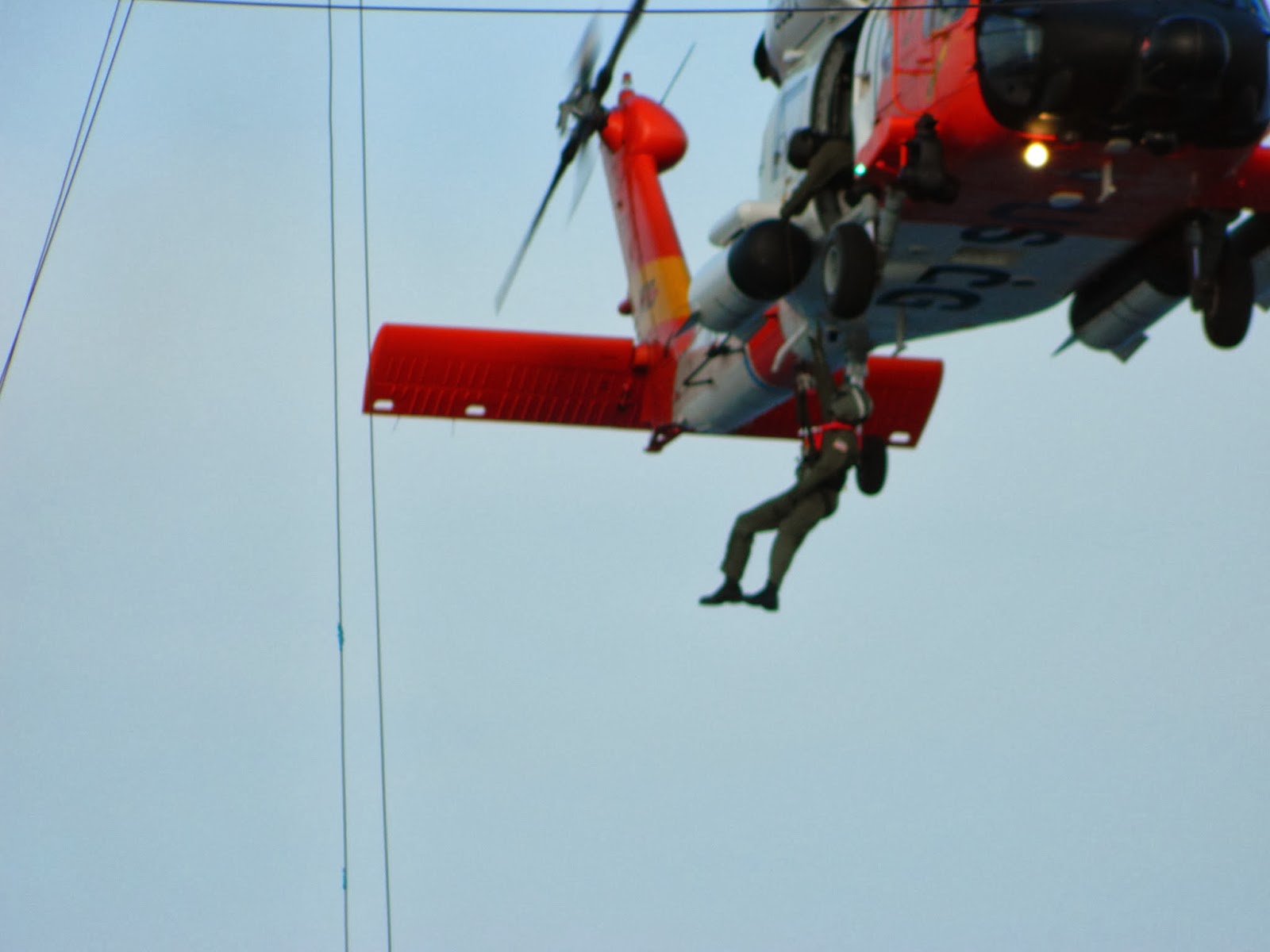
Finally the Coast Guardsman who risked his life dangling from a cable above the ocean's surface to save this person's life was lifted back onto the helicopter


With everyone onboard and the hatch secured the pilot cranked up the helicopter to warp speed and beat a path for Tampa General Hospital.   

With its precious cargo onboard the helicopter began to disappear into the eastern horizon with Tampa General Hospital in its sights.  It was at about this time that the pod of dolphins and the magnificent frigatebird disappeared as well

The US Coast Guard Public Affairs office provided me with a URL for video they took of the rescue.  It can be viewed at this link.

When the ship needed help the Captain didn’t radio a for-profit corporation in Tampa to come rescue the passenger, the Captain called the Federal government.  When there was a need to rescue someone from the deck of a rocking ship the Captain didn’t call a company owned by the Koch Brothers to come perform a rescue, he called the Federal government.  Pseudo intellectuals like Rush Limbaugh and Glenn Beck can wax poetic about how horrible government is and what a waste of money it is to pay government employees.  People like Senator Rand Paul (R-KY), or Senator Ted Cruz (R-Canada) or Sarah Palin (R-Outer Space) can tell you with a straight face that government isn’t the solution, but that government is the problem and therefore government needs to be cut off at the knees.  But I can bet with nearly 1,000 percent certainty that if any one of those people ever suffered a heart attack on a cruise ship they would tearfully embrace the federal employee who selflessly risked his life to save theirs.

There was an interesting sidelight to this story that unfolded as the real drama was occurring onboard.  Not many minutes before the helicopter arrived, a pod of bottle-nosed dolphins appeared along the starboard side of the ship.  I had not seen a single marine mammal or a single seabird all day long but now with the helicopter on the horizon these dolphins appeared and they remained swimming alongside the ship.  At about the moment the helicopter took its position aft of the ship on the port side a magnificent frigatebird appeared out of the blue and flew behind the ship.  Both the dolphins and the frigatebird remained in place the entire time the Coast Guard evacuation operation was underway.  Less than a minute after the helicopter sped away the dolphins sped away from amidships on the starboard side and the frigatebird disappeared from port. 

There are many known instances where people have become in trouble in the ocean and a dolphin has shown up out of nowhere to stay with the person until help arrived.  It was almost that way with the pod of dolphins.  It was as if they sensed someone was in trouble on board and it was their job to protect them until help could arrive.  Seems farfetched I know but I have no other explanation for the arrival of the animals and their departure both coinciding with the arrival and departure of the Coast Guard.

I don’t believe in god and I don’t believe in any other cosmic deity.   What I do believe in is karma and karma is the only way I can logically explain the arrival and departure of those animals in the ocean that stayed long enough to make sure everything was ok and then they disappeared.

Sunday, January 19, 2014

Ending the Florida State Park Passport Stamp Program is Not a Wise Move

The Florida State Park Service's Passport to State Parks Book

The National Park Service began a program called “Passport to Your National Parks” in 1988.  In the program each of the units of the National Park Service system (there are now 401 separate units) maintains a stamp (or stamps – depending on how large the unit is) that resembles a stamp that travelers get in the real passports when they travel to a foreign country.  The purpose of the passport stamp program is to encourage the public to get out and enjoy national parks – and if they are lucky to learn something about the nation in which they live.   Currently I have visited 393 of the 401 units of the National Park Service system and have obtained a little over 1,000 individual stamps from all of the parks, monuments, national historic sites, national seashores and other parts of the system that are maintained by the agency.

The Florida Park Service, an agency of state government that has twice received an award for being the best state park system in the nation, initiated a passport stamp program similar to the National Park Service.  I discovered this program in April 2008 not long after I moved to Florida.  Given the intense interest that the passport stamp program created in me for the National Parks, I purchased my first state passport book at Collier-Seminole State Park near Naples, and started traveling around Florida attempting to visit all of the parks.  And I have – six times.


An example of a Florida Park Service passport stamp for one of its units

Florida State Parks extend from Perdido Key on the Alabama border near Pensacola, east to Little Talbot Island on the Atlantic Ocean near Jacksonville.  From there they extend down both coasts to Fort Zachary Taylor at the end of the road in Key West.  State lands include vast expanses of what once was at Kissimmee Prairie Preserve in Okeechobee County (my all-time most favorite state park) to tiny areas surrounding natural springs like Troy Springs in the Panhandle.  State Parks are as diverse as the state itself with historical state parks like Ybor City Museum State Park in Tampa where you can learn about the early Cuban cigar makers on Florida’s west coast to Olustee Battlefield State Park in Baker County where once again the Union forces were defeated by the Confederates (but….remember Richmond and Petersburg and …oh right…who signed what at Appomattox!) to beautiful botanical gardens like Eden Gardens in Walton County near Santa Rosa Beach.  Florida State Parks are in many cases the best of what is left.

When I began seeking out state parks I did so with three objectives in mind.  The first objective was to visit every park; second to learn about the history and geography (flat!) of my adoptive state; and third to work on finding as many species of birds possible in each of Florida’s 67 counties. In many places (around Ratworld or in Miami for instance) state parks are the only places where you can get out and walk in a forest and not be trespassing on private land.  I finished my first circuit of state parks, obtaining a passport stamp for each, at Fort Zachary Taylor in Key West. There I purchased a second passport book and worked my way back up the Keys and across the state to Perdido Key at Pensacola.  When I completed the first circuit and turned in the certification form, the Florida Park Service gave me a front license plate as an award.  They gave me a second front license plate after the second complete circuit of all state parks.


The next thing west from Perdido Key State Park is the Flora-bama Bar on the Alabama/Florida state line made famous in a Jimmy Buffett song

For the third adventure across the state I added to the effort a desire to take a picture of the entrance sign of every park in the system.  Now if anyone questioned me or doubted my effort I had a picture of every park entrance to prove I had been there.  As of today the only park entrance sign I am missing is Anclote Key offshore from Tarpon Springs. The original sign was blown over in a hurricane and has not been replaced.


If you don't have a boat or a kayak, your only option for visiting Mound Key in Estero Bay near Fort Myers is to swim

At the conclusion of my third circuit of the system I received a letter from the Director of the Florida Park Service and with it was a free annual pass to all of the state parks.  I received another annual pass after my fourth circuit and yet another after the fifth time I had visited all of the state parks.


Some spectacular botanical resources are protected in Lignumvitate Key Botanical State Park in the Florida Keys. Watch for sand sharks under your kayak as you paddle to the park

My sixth and most recent successful circuit of all the state parks ended on Friday January 17, 2014, when the helpful people at the front desk of Gamble Rogers State Recreation Area near Flagler Beach stamped my passport book.  As this was happening I learned from the park manager that the Florida Park Service was going to discontinue the passport stamp program.  The park manager didn’t know the reason(s) why but hearing the news was really depressing.  It is such a simple, almost cost-free incentive for Florida residents and visitors to explore every nook and cranny of this state I can’t believe that people would want to end it.


The form certifying my sixth successful circuit of the Florida State Park system.  It was filled out by helpful staff at Gamble Rogers State Recreation Area near Flagler Beach.  My address is blocked off from the bottom of the form below my name

I wrote a letter to the Florida Park Service transmitting the certification of having visited each state park again.  Included in the letter (copied to the very helpful director of the park system) are my reasons for why, as the old idiom goes, eliminating the passport stamp program would be “a penny short and pound foolish.”  That letter is included with this blog post.


If you have had a similar positive experience with the Florida Park Service and all of its 140 or so units, please contact the agency and your local representative in the state legislature.  Encourage both to not make the huge mistake of ending a program that drips with good and about which I cannot find a single thing that is not positive.

January 19 2014


Passport Stamp Program
Homosassa Springs Wildlife State Park
4156 South Suncoast Boulevard
Homosassa Springs, Florida 34446

Dear Florida Park Service

Attached is my certification of having completed another circuit of the Florida State Park system.  Your records should show that this is my 6th complete circuit of your system and the 6th passport stamp book that I have filled.  The final park visited on this circuit was Gamble Rogers near Flagler Beach.

While at Gamble Rogers I heard the disturbing news that consideration is being given to suspending or eliminating the passport stamp program and I hope this is only a discussion item and no decision has been made.  I have lived in Florida for six years and in that time I have tried to find as many species of birds as possible in each of Florida’s 67 counties.   In many places about the only public land available where you can get out and walk in wild habitat is in state parks (think Oleta River, Honeymoon Island, Wekiwa Springs for example).  Seeking out public lands for bird watching and then adding to it the challenge of filling in the passport books has been one of the most enjoyable parts of living in Florida for me.   In the process I have learned an incredible amount about the history of my adoptive state, its geography, and some of the colorful characters that make up its population.  Credit for that lies largely with the passport stamp program.  I started chasing after National Park Service passport stamps in 1995 and it is because of them that I have now visited 393 of the 401 units of the National Park Service system.  The same passion has overtaken me in Florida.  The program for National Park Service sites has grown so popular that an organization, The National Park Travelers Club, has been formed.  It includes thousands of dedicated passport fans and more importantly thousands of National Park Service fans.

Thinking about it since hearing this news on Friday I cannot come up with a single reason to eliminate the program.  The books cost the state nothing because participants buy the passport books.  Local economies are bolstered by the money brought to them by people visiting the State Parks to obtain passport stamps and the message of your agency is enhanced by knowledgeable people seeking out passport stamps.  If the issue is the time it takes away from staff to stamp passport books I think the National Park Service program has the answer for you.  All of the National Parks have a Passport Stamp Station set up in their visitor center.  Travelers simply walk in the visitor center, find the station and affix the stamp to their passport book themselves.  The stamps are attached to a table by a chain so they can’t be stolen and the entire process takes a matter of seconds all the while park staff are attending to other visitors and not involved with the process.  Obtaining a Florida stamp is an elaborate affair that takes a couple minutes of staff time because Florida staff believe it is necessary to basically hide the stamps until you ask for one and then they personally affix the stamps for visitors.  Setting up a stamp station in each State park office similar to the ones in the National Parks would eliminate that process and free up more staff time to attend to other issues.  This is a very simple solution.

In my six years residence in Florida as I have traveled from Perdido Key to Little Talbot Island to Fort Zachary Taylor I have met a lot of people who are also seeking out passport stamps.  Every one of them I have met and talked to has raved about the program and how it has been a great incentive for them to get out and explore Florida.  The passport stamp program has done the same for me and in the process I have contributed thousands of dollars to the state’s economy as I have traveled all over it. 

There is an old idiom that talks about decisions being “a penny short and pound foolish” which generally is interpreted to mean that doing something small now will prevent bigger issues later.   I think that idiom can be applied to the passport stamp program.  The Florida State Park system is building a cadre of dedicated individuals who will go to bat for you with legislators and others who might seek to harm the agency, its budget and its programs if you asked us.  Why would people want to end something that produces only positive outcomes for all involved?

 I hope that Florida Park Service doesn’t make a penny short and pound foolish decision to end such a successful and advantageous program.  If there is anything I can do to help change the outcome of what I was told at Gamble Rogers I would gladly help you.

As an aside, I have purchased another passport stamp book and I’m now working on my seventh circuit of your excellent park system.

xc:  Director, Florida Park Service