Thursday, February 27, 2014

An Air Evacuation on the High Seas - Thanks U S Coast Guard!


Wednesday morning February 26 2014 was uneventful onboard the Carnival Cruise line ship the Carnival Paradise until a 66 year old male passenger on the Lido Deck (Deck 10) suffered a heart attack.  The ship was about 400 nautical miles southwest of Tampa and was returning from a five-night cruise to Grand Cayman and Cozumel, Mexico.

If the heart attack wasn’t enough, upon being stricken the passenger fell forward clobbering his forehead on the edge of the swimming pool.  Later reports said the heart attack victim also suffered a concussion from colliding with the swimming pool.  Other passengers surrounded the stricken person and soon the ship’s medical staff arrived to care for him.  He was taken downstairs to the Medical Center on the 3rd deck and nobody heard anything else about the passenger or his status until mid- afternoon.  It was then that the ship’s captain informed us over the intercom that the passenger was not doing better, that he could not wait for our arrival 18 hours later in Tampa, and that more sophisticated medical treatment was required to keep the passenger alive.

The captain’s alternative was the United States Coast Guard.  He informed us that we would continue to steam northeast to a point about 180 miles southwest of Marco Island Florida where we would be intercepted by a MH-60 Jayhawk helicopter from Coast Guard Air Station Clearwater.  The Coast Guard would perform a daring air evacuation of the patient (the Carnival Paradise does not have enough of an unobstructed deck to allow a helicopter to land) from the aft of the 11th deck.  


The air evacuation took place on the right hand side of this picture behind the large red smoke stack. Note that there is very little room to manuever on that deck.  This picture was taken about 8:00 a.m. or about 8 hours before the evacuation 

Other than watching the excellent Kevin Costner movie The Guardian about a thousand times and watching shows about the Coast Guard on The Weather Channel, my experience with the Coast Guard had been limited to one incident in the Florida Keys 30 years ago.  Its funny to think back on it now but it wasn't so humerous as it unfolded. 

Using my Federal employee status I talked with the commander of Coast Guard Station Marathon and was invited to accompany their patrol boat going out to the Gulf Stream one Saturday afternoon in July 1984 while I was in the Keys doing research.  The Coast Guard's purpose that day was to look for stranded vessels; I was there to look for seabirds in the Gulf Stream waters just a few miles offshore. When I arrived at Station Marathon I was given a quick briefing on how to keep from being thrown overboard if we encountered rough seas.  Afterward we set sail for the cobalt blue waters of the Gulf Stream.   Not long after leaving the Station, we received a call instructing us to be on the lookout for a stolen boat.  Hearing this, the boat’s captain knew exactly where to look and we changed course for the Cuban Docks on Vaca Key.  

We had a description of the boat but to me they all looked the same.  As we made our approach to the docks the captain asked me to stand in the bow with my binoculars and read the registration numbers on we passed. This was exciting at first but soon it became boring.  That all changed when we came on to a thirty-foot shrimp boat because sitting in its wheel house was a simple, lone, unassuming marijuana plant that was growing in a bucket.  Not thinking much of it I casually mentioned to the captain that there was a marijuana plant in that boat and was he interested in it?  He took my binoculars, looked at the potted pot plant and exclaimed, “I’m going to seize that boat!” 

Our plans changed again when the pot plant was found.  We docked the Coast Guard vessel next to the shrimp boat and kept it under surveillance and then radioed the U.S. Customs Service and the Monroe County Sheriff’s Department to alert them to our find and both groups said they would send backup.  This was followed by the rather dramatic laying on of guns.  Two of the four Coast Guardsmen were designated the boarding party.  It was their responsibility in these situations to board boats and look for contraband.  The boarding party strapped on their .45 caliber revolvers and waited for Customs and the Sheriff to arrive. 

Arrival of the reinforcements meant that the boarding party could jump into action and as they approached the shrimp boat, one of the two Coast Guardsmen still on the boat went below decks and came out carrying three 12 gauge shotguns.  He handed one shotgun to the boat captain and then loaded a shell in the chamber of the second gun and kept it for himself.  He then turned to me.

“You’re a Fed aren’t you,” he asked.

“Yes,” I said, “but I’m not in law enforcement.”

Thrusting the loaded shotgun in my hands he yelled “If they shoot, shoot back!”

With their guns drawn, the boarding party approached the shrimp boat.  As instructed I stood in the bow of the boat with the 12 gauge shotgun aimed at the wheel house.  It was my responsibility to shoot if anyone shot first.  Between them the four-person boarding party had enough armaments to support a small insurgency in Nicaragua and as they made their way to the shrimp boat I maintained my aim at the unseen doper inside.

With guns drawn the boarding party walked up to the main door of the shrimp boat and yelled at the occupants to come out.  Nobody inside moved.  They yelled again and still nobody moved.  At the conclusion of the third yelling session, one of the Coast Guardsmen on the boat kicked in the door.  I flicked off the safety on my shotgun.  

No shots rang out as the four men entered the shrimp boat to confiscate the lone marijuana plant in the wheel house.  After what seemed like an hour inside they returned to the main door leading a rather disheveled individual who was shirtless and shoeless (this was the Florida Keys after all) man with scraggly hair.  His arms were securely behind his back and his wrists were held together by hand cuffs.  The Customs Agent yelled at us and told us they had found some cocaine on the table along with the malevolent marijuana plant.  He also informed us that we could take down our arms and prepare to tie off the boat.

With the boat shrimp boat secured to the Coast Guard cutter we slowly made our way back to Coast Guard Station Marathon where it was tied off and guarded by another Coast Guardsman who proceeded to do about face marches in front of the boat.  It was his responsibility to ensure that nobody came near that shrimp boat unless they were personally known to the Coast Guardsman.  Should some nefarious individual attempt to board the boat before the Customs Service could tear it apart, it was this Coast Guardsman’s responsibility to shoot that person.  Later on tearing apart the inside of the shrimp boat Customs found a large cache of cocaine stuffed between the walls below decks.

Fast forward to February 26 2014 at a point about 180 miles southwest of Marco Island.  Many passengers had assembled on the 12th Deck about 4:30 this afternoon waiting for the arrival of the Coast Guard about 5:00 p.m.  Fifteen minutes early I saw a helicopter on the horizon and followed its approach to the ship.  As it approached the Captain turned the ship into the wind to provide better air flow for the soon-to-be-hovering helicopter.  Making his approach to the ship the pilot made a 360 degree survey of the ship to assess the situation and then approaching the aft deck on the port side began the laborious process of getting safely into position to send a Coast Guardsman from the helicopter, supported by nothing more than a thin cable, to the deck of the ship.  The greatest danger at this point was the combination of wires strung above the upper deck, the humongous smoke stack at the rear of the ship and the small area (later measured at about 60 feet of clear space) into and over which the pilot could safely maneuver.

Finally satisfied with the location of his helicopter relative to any obstructions that could seriously affect his mission, the pilot gave the go-ahead for a Coast Guardsman to slide down a cable that connected the aircraft and the ship.  Soon a lone Coast Guardsman appeared in the door, hooked up his harness to the cable and while he and the helicopter were about 200 feet over the surface of the ocean, the Coast Guardsman slid down the cable to the deck of the ship.  A few seconds later a stretcher was lowered from to the ship and shortly after that the stretcher, loaded with the heart attack victim, was hauled back onto the helicopter.  With the patient safely onboard the Coast Guardsman was pulled off the deck and into the waiting helicopter.  With the hatch on the helicopter safely secured the helicopter moved away from the ship’s path and following a wide arc sped quickly east to a hospital.  Hopefully the patient survived the ordeal and will have stories to tell about his rescue at sea for many years to come. 

Almost all of the passengers on the ship were glued, in one way or another, to the activates of the rescue helicopter.  A loud round of cheers and applause rose from the crowd when the helicopter arrived.  More applause rang out when the patient was loaded aboard the helicopter and even more cheers could be heard as the helicopter raced away. Overcome with pride after seeing Federal employees risk their lives to save the life of another person I turned to the man standing next to me, a Michigander who had come south for a few days to escape the frozen north country, and said emphatically “The next time you hear some son-of-a-bitch complain about government and government employees you tell them what you saw on the deck of this ship this afternoon.”

It is my hope that every one of the 2000 passengers aboard the Carnival Paradise today also will remember that they witnessed an under-paid government employee selflessly throw himself in the face of danger to slide down a cable to the deck of a ship and save the life of another human being. 

The inbound helicopter from Coast Guard Air Station Clearwater circled the ship first to assess the situation and no doubt make their plan for approaching the task


On arrival one Coast Guardsman stood in the door of the helicopter further determining how to approach the task. Click on the pictures to make them larger for better viewing


One of the many challenges facing the pilot as he prepared to rescue the patient was manuevering the aircraft in the tight space between the large smoke stack and various wires strewn from it.  There was perhaps 60 feet of open space in which to manuever.


Safely positioned the Coasties onboard lowered a cable to the deck.  The patient would be evacuated up this cable

Once the cable was secured to the ship's rail the stretcher was lowered to the ship's deck.  A Coast Guardsman soon followed (I didn't get a picture of his descent)

First the patient's wife was loaded onto the helicopter

Next the patient is loaded onto the helicopter


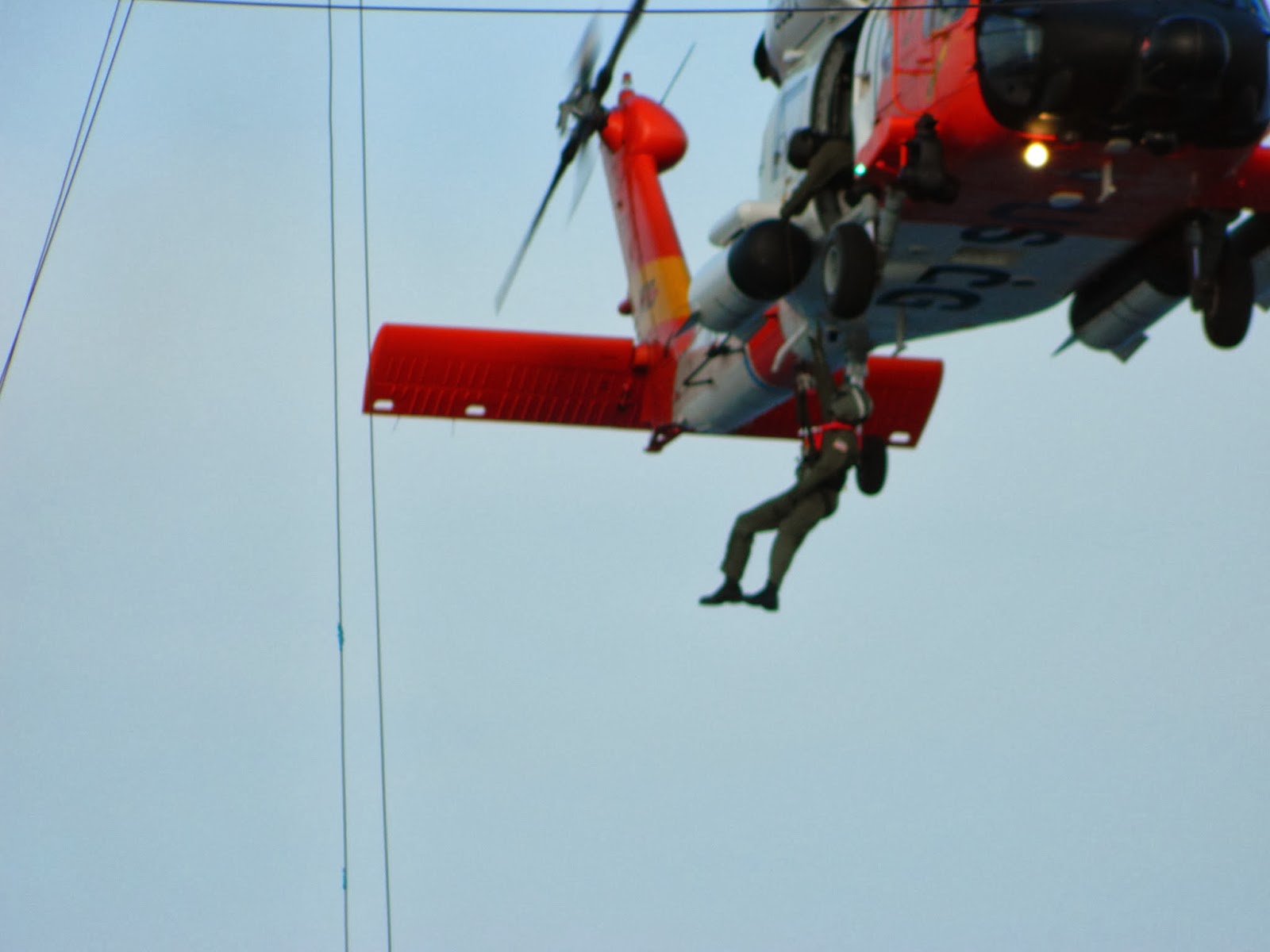
Finally the Coast Guardsman who risked his life dangling from a cable above the ocean's surface to save this person's life was lifted back onto the helicopter


With everyone onboard and the hatch secured the pilot cranked up the helicopter to warp speed and beat a path for Tampa General Hospital.   

With its precious cargo onboard the helicopter began to disappear into the eastern horizon with Tampa General Hospital in its sights.  It was at about this time that the pod of dolphins and the magnificent frigatebird disappeared as well

The US Coast Guard Public Affairs office provided me with a URL for video they took of the rescue.  It can be viewed at this link.

When the ship needed help the Captain didn’t radio a for-profit corporation in Tampa to come rescue the passenger, the Captain called the Federal government.  When there was a need to rescue someone from the deck of a rocking ship the Captain didn’t call a company owned by the Koch Brothers to come perform a rescue, he called the Federal government.  Pseudo intellectuals like Rush Limbaugh and Glenn Beck can wax poetic about how horrible government is and what a waste of money it is to pay government employees.  People like Senator Rand Paul (R-KY), or Senator Ted Cruz (R-Canada) or Sarah Palin (R-Outer Space) can tell you with a straight face that government isn’t the solution, but that government is the problem and therefore government needs to be cut off at the knees.  But I can bet with nearly 1,000 percent certainty that if any one of those people ever suffered a heart attack on a cruise ship they would tearfully embrace the federal employee who selflessly risked his life to save theirs.

There was an interesting sidelight to this story that unfolded as the real drama was occurring onboard.  Not many minutes before the helicopter arrived, a pod of bottle-nosed dolphins appeared along the starboard side of the ship.  I had not seen a single marine mammal or a single seabird all day long but now with the helicopter on the horizon these dolphins appeared and they remained swimming alongside the ship.  At about the moment the helicopter took its position aft of the ship on the port side a magnificent frigatebird appeared out of the blue and flew behind the ship.  Both the dolphins and the frigatebird remained in place the entire time the Coast Guard evacuation operation was underway.  Less than a minute after the helicopter sped away the dolphins sped away from amidships on the starboard side and the frigatebird disappeared from port. 

There are many known instances where people have become in trouble in the ocean and a dolphin has shown up out of nowhere to stay with the person until help arrived.  It was almost that way with the pod of dolphins.  It was as if they sensed someone was in trouble on board and it was their job to protect them until help could arrive.  Seems farfetched I know but I have no other explanation for the arrival of the animals and their departure both coinciding with the arrival and departure of the Coast Guard.

I don’t believe in god and I don’t believe in any other cosmic deity.   What I do believe in is karma and karma is the only way I can logically explain the arrival and departure of those animals in the ocean that stayed long enough to make sure everything was ok and then they disappeared.

Sunday, January 19, 2014

Ending the Florida State Park Passport Stamp Program is Not a Wise Move

The Florida State Park Service's Passport to State Parks Book

The National Park Service began a program called “Passport to Your National Parks” in 1988.  In the program each of the units of the National Park Service system (there are now 401 separate units) maintains a stamp (or stamps – depending on how large the unit is) that resembles a stamp that travelers get in the real passports when they travel to a foreign country.  The purpose of the passport stamp program is to encourage the public to get out and enjoy national parks – and if they are lucky to learn something about the nation in which they live.   Currently I have visited 393 of the 401 units of the National Park Service system and have obtained a little over 1,000 individual stamps from all of the parks, monuments, national historic sites, national seashores and other parts of the system that are maintained by the agency.

The Florida Park Service, an agency of state government that has twice received an award for being the best state park system in the nation, initiated a passport stamp program similar to the National Park Service.  I discovered this program in April 2008 not long after I moved to Florida.  Given the intense interest that the passport stamp program created in me for the National Parks, I purchased my first state passport book at Collier-Seminole State Park near Naples, and started traveling around Florida attempting to visit all of the parks.  And I have – six times.


An example of a Florida Park Service passport stamp for one of its units

Florida State Parks extend from Perdido Key on the Alabama border near Pensacola, east to Little Talbot Island on the Atlantic Ocean near Jacksonville.  From there they extend down both coasts to Fort Zachary Taylor at the end of the road in Key West.  State lands include vast expanses of what once was at Kissimmee Prairie Preserve in Okeechobee County (my all-time most favorite state park) to tiny areas surrounding natural springs like Troy Springs in the Panhandle.  State Parks are as diverse as the state itself with historical state parks like Ybor City Museum State Park in Tampa where you can learn about the early Cuban cigar makers on Florida’s west coast to Olustee Battlefield State Park in Baker County where once again the Union forces were defeated by the Confederates (but….remember Richmond and Petersburg and …oh right…who signed what at Appomattox!) to beautiful botanical gardens like Eden Gardens in Walton County near Santa Rosa Beach.  Florida State Parks are in many cases the best of what is left.

When I began seeking out state parks I did so with three objectives in mind.  The first objective was to visit every park; second to learn about the history and geography (flat!) of my adoptive state; and third to work on finding as many species of birds possible in each of Florida’s 67 counties. In many places (around Ratworld or in Miami for instance) state parks are the only places where you can get out and walk in a forest and not be trespassing on private land.  I finished my first circuit of state parks, obtaining a passport stamp for each, at Fort Zachary Taylor in Key West. There I purchased a second passport book and worked my way back up the Keys and across the state to Perdido Key at Pensacola.  When I completed the first circuit and turned in the certification form, the Florida Park Service gave me a front license plate as an award.  They gave me a second front license plate after the second complete circuit of all state parks.


The next thing west from Perdido Key State Park is the Flora-bama Bar on the Alabama/Florida state line made famous in a Jimmy Buffett song

For the third adventure across the state I added to the effort a desire to take a picture of the entrance sign of every park in the system.  Now if anyone questioned me or doubted my effort I had a picture of every park entrance to prove I had been there.  As of today the only park entrance sign I am missing is Anclote Key offshore from Tarpon Springs. The original sign was blown over in a hurricane and has not been replaced.


If you don't have a boat or a kayak, your only option for visiting Mound Key in Estero Bay near Fort Myers is to swim

At the conclusion of my third circuit of the system I received a letter from the Director of the Florida Park Service and with it was a free annual pass to all of the state parks.  I received another annual pass after my fourth circuit and yet another after the fifth time I had visited all of the state parks.


Some spectacular botanical resources are protected in Lignumvitate Key Botanical State Park in the Florida Keys. Watch for sand sharks under your kayak as you paddle to the park

My sixth and most recent successful circuit of all the state parks ended on Friday January 17, 2014, when the helpful people at the front desk of Gamble Rogers State Recreation Area near Flagler Beach stamped my passport book.  As this was happening I learned from the park manager that the Florida Park Service was going to discontinue the passport stamp program.  The park manager didn’t know the reason(s) why but hearing the news was really depressing.  It is such a simple, almost cost-free incentive for Florida residents and visitors to explore every nook and cranny of this state I can’t believe that people would want to end it.


The form certifying my sixth successful circuit of the Florida State Park system.  It was filled out by helpful staff at Gamble Rogers State Recreation Area near Flagler Beach.  My address is blocked off from the bottom of the form below my name

I wrote a letter to the Florida Park Service transmitting the certification of having visited each state park again.  Included in the letter (copied to the very helpful director of the park system) are my reasons for why, as the old idiom goes, eliminating the passport stamp program would be “a penny short and pound foolish.”  That letter is included with this blog post.


If you have had a similar positive experience with the Florida Park Service and all of its 140 or so units, please contact the agency and your local representative in the state legislature.  Encourage both to not make the huge mistake of ending a program that drips with good and about which I cannot find a single thing that is not positive.

January 19 2014


Passport Stamp Program
Homosassa Springs Wildlife State Park
4156 South Suncoast Boulevard
Homosassa Springs, Florida 34446

Dear Florida Park Service

Attached is my certification of having completed another circuit of the Florida State Park system.  Your records should show that this is my 6th complete circuit of your system and the 6th passport stamp book that I have filled.  The final park visited on this circuit was Gamble Rogers near Flagler Beach.

While at Gamble Rogers I heard the disturbing news that consideration is being given to suspending or eliminating the passport stamp program and I hope this is only a discussion item and no decision has been made.  I have lived in Florida for six years and in that time I have tried to find as many species of birds as possible in each of Florida’s 67 counties.   In many places about the only public land available where you can get out and walk in wild habitat is in state parks (think Oleta River, Honeymoon Island, Wekiwa Springs for example).  Seeking out public lands for bird watching and then adding to it the challenge of filling in the passport books has been one of the most enjoyable parts of living in Florida for me.   In the process I have learned an incredible amount about the history of my adoptive state, its geography, and some of the colorful characters that make up its population.  Credit for that lies largely with the passport stamp program.  I started chasing after National Park Service passport stamps in 1995 and it is because of them that I have now visited 393 of the 401 units of the National Park Service system.  The same passion has overtaken me in Florida.  The program for National Park Service sites has grown so popular that an organization, The National Park Travelers Club, has been formed.  It includes thousands of dedicated passport fans and more importantly thousands of National Park Service fans.

Thinking about it since hearing this news on Friday I cannot come up with a single reason to eliminate the program.  The books cost the state nothing because participants buy the passport books.  Local economies are bolstered by the money brought to them by people visiting the State Parks to obtain passport stamps and the message of your agency is enhanced by knowledgeable people seeking out passport stamps.  If the issue is the time it takes away from staff to stamp passport books I think the National Park Service program has the answer for you.  All of the National Parks have a Passport Stamp Station set up in their visitor center.  Travelers simply walk in the visitor center, find the station and affix the stamp to their passport book themselves.  The stamps are attached to a table by a chain so they can’t be stolen and the entire process takes a matter of seconds all the while park staff are attending to other visitors and not involved with the process.  Obtaining a Florida stamp is an elaborate affair that takes a couple minutes of staff time because Florida staff believe it is necessary to basically hide the stamps until you ask for one and then they personally affix the stamps for visitors.  Setting up a stamp station in each State park office similar to the ones in the National Parks would eliminate that process and free up more staff time to attend to other issues.  This is a very simple solution.

In my six years residence in Florida as I have traveled from Perdido Key to Little Talbot Island to Fort Zachary Taylor I have met a lot of people who are also seeking out passport stamps.  Every one of them I have met and talked to has raved about the program and how it has been a great incentive for them to get out and explore Florida.  The passport stamp program has done the same for me and in the process I have contributed thousands of dollars to the state’s economy as I have traveled all over it. 

There is an old idiom that talks about decisions being “a penny short and pound foolish” which generally is interpreted to mean that doing something small now will prevent bigger issues later.   I think that idiom can be applied to the passport stamp program.  The Florida State Park system is building a cadre of dedicated individuals who will go to bat for you with legislators and others who might seek to harm the agency, its budget and its programs if you asked us.  Why would people want to end something that produces only positive outcomes for all involved?

 I hope that Florida Park Service doesn’t make a penny short and pound foolish decision to end such a successful and advantageous program.  If there is anything I can do to help change the outcome of what I was told at Gamble Rogers I would gladly help you.

As an aside, I have purchased another passport stamp book and I’m now working on my seventh circuit of your excellent park system.

xc:  Director, Florida Park Service

Tuesday, January 14, 2014

Slices of America's Pie is Hot Off the Press!


My publisher just let me know that my latest book, "Slice's Of America's Pie" is hot off the press and available for purchase. Here is what the book is about: 

A simple question posed on a moonlit Wisconsin summer night sent author Craig Faanes on a journey. Tens of thousands of miles later the journey ended on a highway in central Oregon when he had visited every county in the United States. Where most people are content to visit all 50 states, Faanes took the challenge one step further and visited every county in each of the 50 states. His travels provided an intimate glimpse into the foibles and faults and funny characters making up the core of the United States. 

This story began in the 1950s when everyone knew their neighbor and when you could leave a car on the street with the keys in the ignition and fully expect it to still be there when you returned. It ends in the 21st century when the probity of earlier days is more difficult to find. This series of short stories reveals that, despite its sometimes mercurial nature, America’s innocence can still be discovered whether it’s a baffled woman at a Jimmy Buffett concert on Waikiki Beach, or a recently-enlightened Lion’s Club member in Palco, Kansas, or Bonnie the waitress with her bouffant hair do at a truck stop near Cuba, Alabama. The only requirement is a desire to seek out what lies beyond your backyard fence.

The book is now available for purchase from my publisher and if you purchase it from them I recieve a larger royalty. However my publisher charges an extortionate rate for shipping and handling that is simply not fair to you or anyone else who purchases the book.  That being the case I'd highly recommend that you simply purchase it from a bookstore like Barnes and Noble (if its not in stock they can order it for you) or from Amazon.com   Ordering from Amazon usually allows you to enjoy free shipping and handling.  Although these options result in a smaller royalty they don't result in ripping you off on a ridiculous shipping and handling charge!

So, crank up your credit card and buy a copy.  Maybe 10 copies.  I hear it makes a great gift.

The counties used in the story along with the title of each chapter are in this list:

Chapter Titles in Slices of America’s Pie

Chapter
Topic/State
County
Chapter Title
1
Introduction

How It Began
2
Alabama
Sumter
Black-eyed Peas for Lunch
3
Alaska
Northwest 
Staring Down a Moose
4
Arizona
Cochise
Looking for Trogons with Jennifer
5
Arkansas
Monroe
A Special River Runs Through It
6
California
Monterey
“What Are You Doing to Those Sea Otters?”
7
Colorado
Jefferson
When A Leader Can’t Be Trusted
8
Connecticut
New London
A Tropical Outpost on a Connecticut River
9
Delaware
Kent
Bombay Hook Isn’t In India
10
Florida
Monroe
If They Shoot, Shoot Back
11
Georgia
Clark
What Language Are You Speaking?
12
Hawaii
Oahu
The Best Buffett Concert Ever
13
Idaho
Lemhi
Two Million Acres of Wilderness
14
Illinois
Pulaski
A Safe Haven for Venomous Snakes
15
Indiana
Montgomery
Fossil Hunting in Crawfordsville
16
Iowa
Des Moines
Walking in Aldo Leopold’s Footsteps
17
Kansas
Rooks
A Meeting of the Palco Lions Club
18
Kentucky
Muhlenberg
Mr. Peabody’s Coal Train
19
Louisiana
Lafayette
The Gator Cove
20
Maine
Washington
Barna Norton’s Puffins
21
Maryland
Somerset
See It Before It’s Gone
22
Massachusetts
Dukes
Is Carly Simon On The Island?
23
Michigan
Keweenaw
Wolves and Moose and a Great Lakes Island
24
Minnesota
Hennepin
When WCCO Radio Ruled the Upper Midwest
25
Mississippi
Jackson
The Pascagoula Run
26
Missouri
Greene
A Baseball Game in the Ozarks
27
Montana
Gallatin
Hunting the Elusive Wapiti
28
Nebraska
Hall
Tornado Warning!
29
Nevada
Elko
On Top of the Ruby Mountains
30
New Hampshire
Coos
This Car Climbed Mount Washington
31
New Jersey
Cape May
The Marshes of Avalon
32
New Mexico
Hidalgo
The Mexican Mountains of New Mexico
33
New York
New York
An Irrational Fear of a City
34
North Carolina
New Hanover
My First Time on the Ocean
35
North Dakota
Stutsman
Tranquility Wrapped in Prairie Grasses
36
Ohio
Portage
Never Forget Kent State
37
Oklahoma
Oklahoma
In the Aftermath of Timothy McVeigh
38
Oregon
Deschutes
The End of the Quest
39
Pennsylvania
Delaware
An Urban Center for Environmental Education
40
Rhode Island
Washington
The Clam Diggers of Point Judith Pond
41
South Carolina
Charleston
Where the Northern War Began
42
South Dakota
Harding
“We’re All Going to Die” 
43
Tennessee
Moore
The Dry Home of Gentleman Jack
44
Texas
Hidalgo
The Potential Energy of Dwight Lee
45
Utah
San Juan
Monkey Wrenching With Hayduke
46
Vermont
Essex
The Northeast Wilderness
47
Virginia
Arlington
Riding the Orange Line
48
Washington
San Juan
Where Killer Whales are Guaranteed
49
West Virginia
Cabell
A Wild Plane Ride from Pittsburgh
50
Wisconsin
Pierce
On The Banks of the South Fork
51
Wyoming
Teton
The Otters of Teton Marsh