Thursday, August 11, 2011

Don't Ever Rent from Dollar Rent-a Car


August 11, 2011

Dollar Rent A Car, Inc.
Attn: Customer Service 2W2
P.O. Box 33167
Tulsa, Oklahoma 74153-1167

Dear Customer Service

I recently had a Dollar Rent-a-Car rental at the airport in Cancun Mexico. The rental period was from August 3, 2011 through August 9, 2011; a six-day rental.

At the time I made my reservation online at www.dollar.com I was quoted a rate of $78 US for the six day period. This was by far the cheapest rate quote I had received from any of the major rental car companies so I accepted the rate and made the reservation. At no time during the reservation process was there any mention of “extras” like “mandatory” insurance or a 15 percent airport fee or anything else. I was led to believe by your own online information that I was going to get rental car for 6 days for $78US. Pretty good deal, huh?

Imagine my surprise on arriving at your counter at the Cancun airport to find out that the $78 US quote had inadvertently not included the “mandatory” collision insurance that cost me an additional $72 US for the rental period. I explained to the rental agent in Cancun that my American Express card covered all of my insurance needs on foreign rentals (I got this directly from American Express before traveling to Mexico – their insurance, they said, covered liability, damage, medical, and everything else). Not wanting to delay my vacation any longer I reluctantly accepted the $72 US insurance. This brought my rate up to $150 US a week. This was certainly not what I was told by Dollar but it still was a reasonable rate.

Before leaving the airport on August 3 I noted on the rental agreement that the car was ¾ full of gasoline. However when the car was presented to me it had maybe 1/8 of a tank of gas in it. Dollar never changed this on the rental agreement. Instead they just smiled at me. I immediately purchased gasoline and brought back the car completely full.

During the rental period at one of my gasoline refilling stops I was informed by a Pemex gas station employee that the oil level in the car was so low that it wasn’t registering on the dipstick. This made sense because the car had been running hot for the last day or so.To confirm this I put the dipstick in the engine myself, removed it, and looked at the level. Sure enough, there was no oil showing on the dipstick. Rather than letting your car explode from no oil in it I purchased 3 liters of oil from Pemex for the extortionate rate of $400 Mexican pesos (at the current exchange rate of 11.02 Pesos per dollar that is $36.36 or $12.12US per liter). This brought the oil level up to just over the “add” line. At least your car engine wasn’t going to throw a rod. I made a mental note to make sure I brought this up with your agent at the Cancun airport.

On my return to the Cancun airport on August 9, 2011 I first told your rental agent about the car being without oil on the dipstick. He informed me that this was a common scam among Pemex gasoline stations in Tulum, Playa del Carmen and in Cancun. The idea is to convince a traveler that their car is out of oil and then sell them high-priced oil. Only problem is – I saw the dipstick before he put in oil and I saw it after 3 liters were put in and only after 3 liters were added did it register there was enough oil to proceed. Your rental agent told me that “we get one renter a day who gets scammed like this.”

I asked your rental agent that if this supposed scam is so common why are they not warning renters about it before they leave the rental car lot. His reply was that in the future I should check the oil level before I drive off the lot.

I was born in the morning, just not yesterday morning. It is pretty obvious to me that the oil level was dangerously low in the car, that Dollar sent me out on strange highways with a car that was not adequately equipped, and when confronted with this fact, Dollar decided to blame me for the mistake.

After discussing the oil issue I was handed the final bill. It is attached for your reference. It was $2,657.37 Mexican Pesos. At the current exchange rate of 11.02 pesos per dollar that translates to $239.32 US.

That is one hell of a lot more than the original “guaranteed” rate of $78 US that I was quoted when I made the reservation. In fact it is $161 US more than the original rate.

I know from past experiences with other rental car companies who deceive their customers in foreign locations that you will come back with one of two standard refrains. Most likely it will be 1) We weren’t present at the time of rental so we don’t know what actually was quoted (this in spite of the fact that you can look up my original rental and see that you quoted me $78 US for the six days), or 2) The Dollar office at the Cancun airport isn’t really a Dollar office. It’s just an affiliate (This in spite of the great big sign saying “Dollar Rent a Car” over the door, the sticker on my keys saying “Dollar Rent a Car” and even the “Dollar Rent a Car emblem on the attached receipt for the $239.32 US I paid for this $78 rental. Because it’s not a real Dollar office you can’t be held responsible for what goes on there.

That of course is pure bullshit because this rental began at www.dollar.com which, if I am not mistaken, is your company’s website for making reservations such as the one I made.

I am not writing to request an adjustment on the bill because you snookered me. There is no doubt several corporate policies against doing so. After all its more important to overcharge someone $161 US than to ever have them rent from you again. I am writing however to request that in the future you come clean with people when they are making reservations on your website and tell them UPFRONT what all the costs are going to be. I am also requesting that you instruct your staff in the Cancun airport to begin telling your customers about this alleged scam with Pemex claiming that their car is out of oil. My guess is that when you start demanding that of your staff in Cancun suddenly Pemex will not be so remiss any longer.

The one thing I am doing with this letter is returning my Dollar Express card # 0100265565 because this is far and away the very last time I will ever EVER rent a vehicle from Dollar. I plan to post this letter on my blog (www.watchingthesunbake.blogspot.com) and also post it on my Facebook page so other travelers know up front what a less than reputable organization they are dealing with at Dollar.

Thursday, July 28, 2011

On Restoring the Health of a Wisconsin Lake


Editor
Rice Lake Chronotype
Rice Lake, Wisconsin

Dear Editor

I read with great interest your recent story on attempts to restore the health of Rice Lake; a most noble effort and long overdue.

The lake restoration plan seems to rely strongly on the removal of tons of aquatic vegetation without getting at the root cause of the profusion of aquatic vegetation - runoff from agricultural fields and residential lawns in the lake's watershed. This issue is not new. The lake was choked with aquatic vegetation in 1969 - the year I graduated from Rice Lake High School.

There is a simple but obvious reason all of those aquatic plants are growing in profusion. They are being fed by tremendous loads of fertilizers, from nitrogen sprayed on fields to cow manure spread on the fields to fertilizers applied to someone's rose garden on East Stout Street. Until nutrient enriched runoff is reduced or eliminated in the watershed, all the grants in the world and all the weed cutting machines in northern Wisconsin wont help make the lake "healthy."

Craig Faanes

Thursday, July 21, 2011

A Scientific Name for Tea Bag Anarchists


This evening while doing my 14 mile bicycle ride I gave considerable thought regarding the need to come up with a functional scientific epithet for the Tea Bag Anarchy wing of the Republican Party. After all they are animals and with luck they will soon be endangered (and with no recovery effort they'll go extinct).

As I pedaled I decided that it would be inappropriate to put anything in the name like "moron" or "idiot" because those words, although being highly descriptive and completely correct, would be offensive to morons and idiots everywhere. I also decided to avoid any "obvious" swear words like "dumbfuckii".

After considerable thought I finally decided that the proper genus and species for the Tea Baggers should be "Teabaggus dipshitti". Its pretty all encompassing, isn't outwardly too offensive (even though tea baggers are outwardly offensive) and just generally hits the nail on the head.

My only real dilemma was when it came to deciding on the location for the type specimen - the location where the species was first described. Even though they got their start in the pocket of the Koch Brothers and were accepted with open arms on the Fox Fiction Channel I knew I had to be more specific. As much as I tried to find a non-offensive word to describe it, I failed because only one location is really correct - Dumbfuckistan, United States.

Given that Tea Baggers are at least partially mammalian I guess the best place to publish this description of a new species would be in the Journal of Mammalogy. If not there then the Proceedings of the Biological Society of Washington. There or in Mad Magazine but I don't think Mad Magazine is published any longer.

I'm sure others will have other ideas on an appropriate genus and species name for tea baggers but as far as I'm concerned this says it all.

Friday, July 15, 2011

Erroneous Reporting


This morning the Associated Press posted a "news" story on yahoo.com in which they referred to the hyena's at the Transportation Security Administration as "officers." Nothing could be further from the truth so I felt compelled to write to the Associated Press to correct them. The letter was sent to info@ap.org That letter follows:

Dear Associated Press

In this news story posted this morning on yahoo.com news, the Associated Press (that would be you) states that "officers" of the Transportation Security Administration confiscated a number of knives from a passenger at BWI airport.

What is misleading is that the word "officer" implies police authority and police power. If your writer had looked into this he/she would have discovered that TSA employees have no police power. None of them have completed the Federal law enforcement training program at the Federal Law Enforcement Training Center in Brunswick, Georgia, or have they completed any other Federal law enforcement training.

The TSA clowns we see at the nation's airports are glorified baggage handlers who have a badge as part of their uniform. I have asked any number of TSA employees, from Honolulu to Boston, about their lack of training yet they continue to carry a badge, and I've been told "Its part of the uniform." If TSA employees had any police authority (arrest authority) why is it that they always have to contact an actual police officer if there is an issue involving police action? In 2006 I wrote to my then-Congressman in the suburbs of Washington DC and asked why it was that Federal employees at TSA were allowed to parade around with a badge on their shirts when I (at the time) would have been fired had I done that in my agency. The Congressman wrote back that the badge was there to send a message to the traveling public.

So, Associated Press, I suggest you start a trend by 1) correcting the error in this story, and 2) begin to educate the public that the badge on a TSA employee shirt is an ornament with no more power than if Ronald McDonald was wearing it. OK?

Monday, June 27, 2011

Immunization Against Rabies


The Centers for Disease Control and Prevention recommends that travelers to South Africa get vaccinated against rabies and several other diseases before traveling to that country.

I'm headed up to the Manatee County Health Department in a couple hours to receive my inoculations against Yellow Fever and Typhoid. I have to go to the County Health Department because my health care provider (that used to be called your "doctor") doesn't have the vaccine.

Last week when I made the appointment for today I was informed by the Health Department that the rabies vaccination was made up of three shots and each shot cost $210 to be administered. Quick math says that its $630 to be vaccinated against the disease. Ouch!

Just now I called Blue Cross and Blue Shield of Florida to ask if they covered the vaccinations. They do not.

To me that is pretty backward thinking. I guess they prefer to spend tens of thousands of dollars on hospital stays and emergency after-the-fact treatments than to spend $630 to prevent having to spend those dollars.

As Jimmy Buffett says in his song "Migration", "Somethings are still a mystery to me while others are much too clear." I guess its clear that Blue Cross doesn't believe in the old adage "an ounce of prevention is worth a pound of cure."

Saturday, June 18, 2011

What Time Is It In South Africa?


On the day I retired I left my office three hours early and walked to the Ballston Metro Station in suburban Virginia. Before taking the elevator down to the train level for the last time I removed my wrist watch (and some clothing) and threw all of it in the garbage bin by the elevator.

Part of my motivation was to reject the "appearance over substance" mentality that grips the Washington office. Another part of the motivation was to shed my winter clothing and prepare for my departure the next day for Florida. The last part of the motivation was to remove myself from the shackles of being driven by time.

Since that day, February 25, 2008, I have not worn a wrist watch and life is so much nicer this way. Now instead of crawling in bed and dreading the 5:00 a.m. alarm the next morning I go to bed when I want to. If I want to stay up until 3:00 a.m. reading I'll read. If I want to call it a night earlier I will. No longer do I have to be ruled at night by an alarm clock.

The same holds for during the day. My bicycling schedule, especially in spring summer and fall, is regulated by the angle of the sun and by how hard I am slammed by humidity when I walk out the door. If its too much then I wait until later in the day or until the following morning before I ride. That holds whether it's 10:00 a.m. or 3:00 p.m.

In pinch times, such as when I have to walk to the bus stop nearby (our local bus system is the Sarasota County Area Transit - SCAT. Honest to cosmic deities its the SCAT bus) I look at the clock on my computer or my Blackberry and know when to leave. Other than that I have just rejected time.

This new found freedom created a small dilemma when I began making plans for my upcoming trip to South Africa. I would have no problem getting to the airport on time for my flight from Sarasota to Atlanta or in making my connection in Atlanta to Jo'burg. There will be clocks and announcements all over the place in the airports.

But what happens when I arrive in South Africa? I wont have my computer with me (just one more reason for someone to rob me) so that option is out. I also wont have my soon-to-be jettisoned Blackberry because the last I checked Verizon doesn't have cell service in South Africa. That option is out.

I will be catching flights internally from Durban to Port Elizabeth, Port Elizabeth to Cape Town, and from Cape Town back to Jo'burg. For each of those flights it will be helpful to know what time it is so I don't miss the flights.

Even more importantly will be knowing what time it is when I am approaching or inside Kruger National Park.


The real dilemma in Kruger is that entrance to each of the "rest camps" (apparently a South African euphemism for really nice hotel and restaurant accommodation scattered throughout the park) close immediately at 18:00 h and don't re-open until 06:00 the next morning.

If you arrive at the entrance gate after closing time you are sunk. Your options are few - sleep in the car and hope you aren't a late night snack for a pride of lions or, well, sleep in your car and hope you aren't a late night snack for a pride of lions. If you are caught outside of the rest camps you are subject to a pretty substantial fine.

Because I refuse to wear a wrist watch ever again, and I wont have my computer or my Blackberry with me, what can I do?

Luckily for me the Dakota Watch Company came up with a solution - the digital compass clip watch.

My sister found out about these in some advertising email she received one day and she forwarded it to me. When I saw this little item I knew that my time telling dilemma in South Africa was over!

It was apparently designed for runners and back packers to clip on to their belt. Because I no longer wear long pants and therefore have no belt, at least I can toss this little gem in a pocket of my day pack and keep track of the time. Some of the cool features include:
Titaniaum Finish
Integrated Carabiner
Electronic Compass with Digital Direction Indication in 16 positions together with degree
6 Operation Modes: Compass, Time, Date, Chronograph, Timer and Alarm
12/24 Hour Display Formats
1/100 Second Chronograph
1 Second Resolution Timer
Daily Alarm
Moonglow ELectro Luminescence
Lightweight Plastic Construction

The company my sister told me about sold the watch for $45.00. The Dakota Watch Company that actually makes the watch sells them for $39.95. Yesterday I found one on Amazon.com for $25.00 (new) so I went with it. An email message a few minutes ago from Amazon informed me that my non-wrist watch shipped today and should be here by Thursday.

Now at least I wont have the verse in this song by Boy George and Culture Club
"time won't give me time" bouncing around in my head any longer as I try to figure out how to keep up on the time without carrying it around on my arm all day long.

Wednesday, June 8, 2011

Fall Migration is Underway


Male Common Grackle. Photo from the US Fish and Wildlife Service collection
Although the calendar says that we still have two more weeks of spring remaining until summer arrives, mother nature, at least in south Florida, has her eyes on fall migration already.

This evening while out bicycling (14 miles in the evening heat!) I encountered the first post-breeding flocks of Common Grackles I have seen this year. Despite some people having a bad taste in their mouth for this rather obnoxious bird (maybe that's why I can identify with it?) I have had a kinship with it for a long time. The research I did for my Master's degree was on the reproductive ecology of common grackles and mourning doves nesting near the Prairie Island Nuclear Generating Facility near Red Wing, Minnesota. For two nesting seasons I climbed up into jack pine trees in a small plantation about 1 kilometer from a nuclear reactor gathering baseline data on these two species. The thinking at the time was that if any environmental issues were being caused by the operation of the nuclear reactor they were likely to show up quickly in birds nesting within a stone's throw of the nuclear reactors.

As part of the research I made daily observations of the behavior of the birds and noticed that usually (at nearly 45 degrees north latitude) when nesting was completed and the young had fledged, the birds gathered in large post-breeding, pre-migrational flocks and flew around the countryside looking for food sources to sustain them through the beginning of winter. With few exceptions common grackle migration was well underway by the middle of August and virtually all of them had vacated the northern latitudes by mid-September.

I started thinking about that this evening when I encountered a post-breeding, pre-migrational flock of common grackles on the north side of Sarasota. The flock, consisting of about 100 birds, was made up of adult males and females and the ratty looking juvenals that hatched this spring.

At this latitude common grackles begin nesting in late February and early March when many other resident birds (northern cardinal, northern mockingbird, Carolina wren, to mention a few) also begin nesting. With a short incubation period of about 13 days and a nestling period of about 14 days before fledging, many young of the year common grackles are already out of the nest by mid-April when many neotropical migrant birds (Kentucky warbler, hooded warbler, black-throated blue warbler to mention a few) are just arriving.

The birds I saw tonight have had at least six weeks of post fledging time to be taught by their parents how to be common grackles. It just seemed strange that they were in pre-migrational flocks in early June!

Which brings up another question - where are they going to migrate to? The range map below, downloaded from the Cornell Laboratory of Ornithology site, clearly shows that a common grackle in south Florida isn't really going to be migrating that much further south. There are some records for the Bahamas and some for Cuba but that's about it in the West Indies. So where to they go when they leave here?

Nesting, Migrational and Winter Range of the Common Grackle
Lacking any band recovery data on Florida-banded common grackles or any satellite tracking data its difficult to guess. All I know is that the local cadre of common grackles is done nesting and setting its sights on some other place to be.


Purple Martin in Flight. Photo from the US Fish and Wildlife Service collection
The other evidence that fall migration is about to begin was the first of the season's post-breeding flocks of purple martins. The flock I saw this evening, made up of males, females, and recently-fledged young, numbered about 20 birds and was seen at the upper end of Cooper Creek Park on the north edge of Sarasota. Another group of maybe 15 birds was hawking insects over the south edge of the artificial wetland and a third flock of 15 birds was along the powerline right of way that passes over Honore Avenue.

Purple martins arrive in south Florida in mid-late January and are busily nesting by the first of March. Producing only one brood per season their nesting responsibilities are largely over by late April and they have nothing to do but get ready for fall migration after that. Most purple martins will have left this part of Florida by the middle of July.

Nesting, Migrational and Winter Range of the Purple Martin
Unlike the common grackle with its southern range limit here in Florida its another story with purple martins. These bird which almost everyone loves to love nest over an extensive area of the Midwest and eastern United States and Canada and spend their winters as far south as north-central Argentina. The bulk of them apparently winter in central Brazil.

Why they migrated that far south and why they leave here in the middle of summer to get there are two questions best left to mother nature to answer.

This little biological conundrum is another reason I enjoy being a biologist and trying to figure out the rhythms of nature. Although fall migration is on the verge of beginning here, in my natal Wisconsin both common grackles and purple martins are just now in the middle of the nesting season. And while that is happening, Arctic nesting shorebirds like red knot and semipalmated sandpipers each of whom were on Sarasota beaches and mudflats a month ago are just now arriving in Arctic Canada and Alaska and setting up territories and thinking about building nests and laying eggs. Most of this is related to 1) sunlight triggering their behaviors, and 2) available food supplies to support young birds at various latitudes. Still its fun to watch and try to figure out what the earth is trying to tell us and why.

Wednesday, June 1, 2011

What a Massive Run Around!!!


A friend of mine is a massage therapist who also does skin care therapy. As part of her business she wants to sell skin care products to her clients. Recently I offered to track down the steps needed for her to get a tax identification number so she could sell skin care products. This work will be done outside of the city of Bradenton so any regulation (you'd think) would be by Manatee County. It hasn't turned out that way.

Launching a rocket ship and landing humans on the moon was easier than getting an answer to her question.

At my sister's suggestion I began by calling the Manatee County Clerk of Court. My sister's reasoning was simple - if there is anything going on in a county the Clerk of Court is going to know about it.

The Clerk of Court had no idea. I talked with a very snotty person there who told me "why are you calling THIS office?? We have nothing to do with that."

I answered, "I know that ma'am. I thought your office would be a good one to start with and maybe you could put me on to the right people."

"Sir" she replied, "I just told you we don't handle that."

I asked her if there was another number I could call.

"Try Manatee County. Their number is 941-748-4501" And she hung up.

Next I dutifully called the brain center of Manatee County government. A relatively courteous person there told me "Believe it or not that is regulated by the County Buildings Department. They are at extension 3800. I will connect you."

Huh?

I talked with Barbara in the Manatee County Buildings Department.

"Oh, no sir. We don't regulate the sale of skin care products. Where did you get that idea?"

"From the Manatee County call center."

"I'm sorry sir. We don't handle that."

"Barbara, do you know which department of county government does regulate it?"

"That sort of thing is regulated by the State not by us. You need to contact the Florida Department of Business and Professional Regulations in Tallahassee. They can help you."

She gave me their number in Tallahassee and I called them. After 20 minutes on hold listening to Barry Manilow music I was finally put in touch with Montrell.

"Before we begin, sir, I want you to know that your telephone reference number for this call is 268823405. Did you get that?"

"Yes Montrell, I have it."

"So, sir, how can I help you today?"

"Montrell, I have a friend who is a massage therapist and who does skin care therapy. She wants to sell skin care products to her clients and wants to know how to get a tax identification number to do that."

"Well, sir, we don't regulate massage therapists but if she's doing facials she will need a license from this department."

"Montrell, I'm not sure what she does with skin care but I know its not facials. Do you know of another agency I could contact?"

"Well, sir, the Florida Department of Health regulates massage therapists. I would call them. Their number is 850-488-0595."

A woman named Barbara at the Florida Department of Health began the call asking "How can I help you?" If she only knew.

Once again I explained what information I sought.

"We don't regulate the sale of skin care products. That is done by the county. I would start with the Clerk of Court in your county. Which county are you in?"

"Barbara," I began, "I started two hours ago with the Manatee County Clerk of Court. They told me to call the Manatee County government center. The government center told me to call the Buildings Department because they regulate these things. The Building Department said they didn't regulate skin care product sales. That was done by the State and I should call the Department of Business and Professional Regulation. The Department of Business and Professional Regulation told me that the Department of Health regulates this topic so I called you. Now you're telling me that I need to go back to the people who started me on this odyssey two hours ago. Doesn't anyone anywhere know who regulates something as simple as the sale of skin care products? How about the State department of Revenue?"

"I'm sorry sir," Barbara concluded, "We require her to have a license to do massage therapy but we don't regulate the sale of skin care products. I have no idea who else you can call."

I hung up with sweat dripping from my forehead.

As part of the requirements for my masters degree I had to write a thesis on a research topic and then defend that thesis and my interpretations before my graduate committee. My committee was made up of my major professor, another biology professor, a math professor and someone from the Education department. On the day of my thesis defense, Jim Richardson, my plant taxonomy professor (who was not on my committee) decided to drop in on the defense. Jim's sole purpose was to harass me.

My thesis dealt with the reproductive ecology of mourning doves and common grackles nesting near a nuclear generating plant along the Mississippi River. I was about one hour into my thesis defense when Jim decided to ask questions. One of them was "Why is the dove the international bird of peace"?

I had absolutely no idea but there was no way I was going to let him know that so I went off on a story telling binge in which I talked about the soft cooing voice and their earth toned plumage color and a bunch of other things that indicated that I had absolutely no idea what was the answer. Still I kept on piling bullshit on top of bullshit until finally, with my hole completely dug, Jim said "Stop!" I stopped. He then said "You don't know the answer do you?" I said I didn't. Jim smiled and said "That's all I wanted to know."

It was a huge lesson that helped me in many situations later in my professional career. It is really liberating to admit to someone that you don't know. It is a phrase I use often even now. Its something that at least five different levels of Manatee County and State of Florida government need to learn and to use.

After the marathon 2 hours on the phone I came up with an idea. Other people in Sarasota and Manatee county do massage therapy and skin care and they sell products. I'll just drive over to one of their offices and ask them how they did it. Where did they get the permit and how to apply.

I started with a salon nearby and was sent to another salon who also didn't know the answer. Next I tried a massage and skin care place in the Suntrust Plaza off Whitfield. The person working there didn't know but she called a Masssage Therapy school in Bradenton. Someone there wasn't sure but would look it up and call me back. The phone has still not rung.

I went to two other salons including one where I applied for a job doing Brazilian waxing a year ago ( I didn't get the job. I think I came off too eager).

Finally after more than four hours of trying to get to the bottom of this seemingly easy question I decided that it had been long enough since my last haircut that I would stop by Great Clips. Not only do they do great hair cuts (for $13 - take that Kenny's Hair Salon in Arlington Virginia that used to charge $40 plus tip for the same cut!) but they also sell hair products retail to their customers. Certainly Great Clips had to have a license or a permit or some damned thing to allow them to sell those products.

Sitting in the chair getting my ever-decreasing crop of hair cut, I asked my hair stylist (that would be a barber in northern Wisconsin) if she knew what permit was needed. She didn't know and the owner wasn't there. I should check back tomorrow when the owner is in.

Frustrated I finished my hair cut and as I turned to leave after paying my bill I glanced up and to my right and there hanging on the wall was the much searched for answer.

The Florida Annual Resale Certificate for Sales Tax. Department of Revenue Form DR-13A

A simple form that gets posted on the wall that nobody looks at and with which employees are not familiar. And it comes from the Florida Department of Revenue - the exact agency I asked the Department of Health about at the end of my conversation with them.

The application process for this certificate is relatively simple.

After more than four hours of trying including two hours on the phone and two hours driving around talking to people who didn't have a clue, I finally found the answer hanging on the wall of a barber shop!

As I wrote down the information about the Sales Tax certificate my hair stylist said "Your friend owes you dinner for going through all of this."

I think that is a good place to begin.

Listen to the Music


Although Charlie Manson was, and remains, certifiably nuts, he once uttered some profound and prophetic words. In an interview nearly 40 years ago, Charlie told the reporter covering him to "Listen to the music. It talks to you every day."

That little quip of Charlie's made me think recently about how a single song was instrumental in changing the course of my life and my career.

In June 1958, while hiking with my maternal grandfather through the patch of woods at the south edge of my grandparents farm, we came upon a pile of dead trees stacked up against my grandparents fence line. The land owner to the south of them had bulldozed a road into the east side of Desair Lake with the intention of eventually subdividing the land and building houses there.

I remember the scene like it was yesterday. The dead trees lay like fallen soldiers against the earth and a huge scar was placed on the land by a bulldozer. I became visibly upset when I saw what had happened to those trees and, like it was yesterday, said to my grandpa that if people kept killing trees like that one day when I was his age there would no longer be any trees. My grandpa consoled me as best as he could and assured me that there would always be trees. I remember thinking then, fifty three years ago, that I was going to make sure that my grandfather was never proven wrong. I think it was then that I decided to become a biologist one day if and when I grew up.

Through my formative years I focused most of my attention on learning about the earth. I picked up road kills and looked at them. I dissected anything that no longer moved to figure out how it worked. I read books and watched television shows and learned how to read the landscape. When I was 9 years old I found a dead duck laying under a powerline near my grandparents farm. The bird possessed a band on one of its legs. I removed the band and sent it to the address written on it. A few months later I received a certificate of appreciation from the US Fish and Wildlife Service. The certificate told me what species of duck it was (already knew it was a Mallard) and its gender (already knew it was a female). I also learned where it had been banded (northwestern Ohio) and when (four years earlier).

I became intrigued that an organization was out there that put bands on bird legs so at age 9 I wrote my first letter to a member of Congress. In it I asked Alvin O'Konski to tell me more about this Fish and Wildlife Service that puts bands on bird legs.

Several weeks later our mailbox was filled with brochures and pamphlets about this mysterious agency that banded birds. After reading every word on every scrap of paper I was provided I decided at age 9 that one day when I was grown up I would be a biologist with the US Fish and Wildlife Service. It was my entire focus from that point on.

At 12 years old I taught myself how to trap muskrats with a few mink and raccoons thrown in by accident. That first year, 1964, I caught five muskrats and a mink and sold this haul to Sam Parker for $6.25. I was a rich 8th grader! As time and experience went on I learned how to catch more and more muskrats. Later I taught myself how to catch red fox and beavers and even caught a river otter once. However I felt so badly after seeing that magnificent animal laying dead in a trap that I never set another one that could catch a river otter.

When I went to college I paid for every bit of my undergraduate degree by selling the furs of the hundreds of muskrats, and tens of mink, and raccoons I would catch in the fall. These funds were supplemented by hundreds of beavers and a few red foxes caught during the winter. I literally became a trapping machine by the start of my undergraduate years.

During winter quarter of my freshman year I took an elective course called Introduction to Geology 101. It was taught by Mr Owen, a retired petroleum geologist with 30 years of experience as a petroleum geologist with Phillips Petroleum. Mr Own had just a bachelors degree but with his 30 years of experience actually doing geology he was able to make the earth come alive to me.

I took Geology 101 and its lab Geology 102 during winter quarter in northern Wisconsin. The class met daily at 8:00 a.m. (in winter no less!) and I never missed a class. Not once.

At the conclusion of Mr. Owens' Geology 101 class I darted over to the registrar's office and declared a double major. There was no way I was not going to take more Geology and I thought I might as well get some credit for the extra classes I took.

So I became a double major. In fact Geology was my first major and Biology my second. If you look at my diploma it says "Bachelor of Science in Earth Science." To get the geology degree I had to take a lot of Physics and in order to understand Physics you need a lot of Math. After all Physics is simply Math in motion.

Through all of the Geology courses I took I developed a special fondness for Invertebrate Paleontology.

My special love became Ordovician age (450 million years old) trilobites. Sam Huffman used to take us on regular weekend fossil trips to the Crawfordsville bioherm near Crawfordsville Indiana. It was there that I learned a great deal about trilobites and about ancient marine environments.

Near the conclusion of my bachelors degree days I was faced with a perplexing decision. Although I loved Biology and especially birds, I was totally immersed in and loved Geology. I simply could not get enough of Geology and especially Invertebrate Paleontology.

Back in the early 1970s about all you needed to get a job was a Bachelors Degree. Having a Masters Degree was like frosting on a cake. Now of course all a Bachelors Degree is good for is getting you the basics needed for Graduate school and a Masters. And now all a Masters is any good for is a stepping stone to a PhD.

At the time however I would have been more than happy with a Masters degree.

Utah State University had an excellent Invertebrate Paleontology program and there was a professor there whose specialty was trilobite ecology. As I read papers this man had written I started to think that I should go to Utah State for at least a Masters degree and to do it in Invertebrate Paleontology.

During the summer of 1971 and 1972 I spent time on Isle Royale National Park in the middle of Lake Superior. While backpacking across the island and avoiding direct collisions with moose, I developed quite a kinship for the island and its nearly intact forest community.

At the time there was a professor at Michigan State University in Houghton, Michigan, who was doing research on the ecology of plant and bird communities on Isle Royale. In correspondence with him I learned that he was interested in taking me on as a graduate student. His plan was for me to get a Masters degree in plant ecology under him and once that degree was finished I would stay on to get a PhD in avian ecology. The plan was to use the botanical data as a base to compare the bird data for my PhD. He had an assistantship that was there for the asking.

I applied to Michigan Tech for a Masters and PhD. However it was still gnawing at me how much I loved Geology and especially the ecology of 450 million year old trilobites. To quench that thirst I applied to the graduate school at Utah State University to get a Masters in invertebrate paleontology. My biggest misgiving about this was that I'd be surrounded by Mormons but I figured I could stomach it for a few years.

On almost the same day I sent my application off to the Utah State University Graduate School I sent another one off to the Michigan Tech University Graduate School. I figured one of them would probably select me.

However on almost the same day several months later I received a letter from Utah State informing me that I had been selected to receive an assistantship for a Masters in invertebrate paleontology. In a separate envelope a couple of days later was a letter of acceptance from the Graduate School at Michigan Tech University informing me that I was selected for a Masters program in Plant Ecology and that the option remained open for me to stay there to work on a PhD in Avian Ecology if I wanted to.

If I wanted to? Who in hell were these people trying to kid?

Now that I had what I wanted I had to make a choice. I'd wanted to be a biologist since almost the time I could walk yet I loved unraveling the mystery of how animals lived millions of years before humans started to trash the earth. Would I be happy doing either? What about those Mormons in Utah? Isn't there a hell of a lot of snow for 10 months of the year in Houghton Michigan?

There were more questions than answers and I wasn't sure how to figure out what I was going to do.

During the 1973 muskrat trapping season I was once again heavily invested in the marshes along Spring Creek east of Rice Lake

I probably learned more about biology along Spring Creek east of Rice Lake Wisconsin than any 10 other places I have ever been.
One morning right after the start of trapping season I was paddling around in Spring Creek checking my traps and trying to decide what to do with my life. Moving to either college town would be a huge break from living just 90 miles down the road in River Falls Wisconsin and at the time that was a daunting possibility. However there was something even more important to decide.

Which career path would do the most good for the earth? I could make tons of money working as a paleontologist with an oil company and at the time oil companies were picking up geologists by the handful. At the same time biologists were not nearly in as much demand although the recent birth of Earth Day helped focus people's attention on biological issues more than they had been for a long time.

What to do? What to do?

On that morning when all these thoughts were passing through my head I started playing John Denver's smash hit single "Rocky Mountain High" in my mind. I couldn't seem to get the lyrics out of my head. I'd loved that song since it first came out and for some reason that morning its lyrics would not leave me alone.

The song begins with:
He was born in the summer of his 27th year
Comin' home to a place he'd never been before
He left yesterday behind him, you might say he was born again
You might say he found a key for every door

And quite surprisingly I was born again in the summer of my 27th year - 1978 - when I spent two months traipsing across the prairie with Hal Kantrud at the Northern Prairie Wildlife Research Center conducting research on the ecology of grassland breeding birds. However that was in the future. In early November 1973 while paddling a 13 foot canoe around Spring Creek, these words by John Denver are what really got to me:
Now his life is full of wonder but his heart still knows some fear
Of a simple thing he cannot comprehend
Why they try to tear the mountains down to bring in a couple more
More people, more scars upon the land

When I heard John Denver singing in my mind about trying to tear the mountain down to bring more scars upon the land, I knew that if I became a geologist that is exactly what I would do. I'd be working for a company raping the earth to extract more oil or coal and leaving huge scars on the land. Those scars would be left to facilitate corporate profits at the expense of the earth and its creatures. I simply could not be a party to that and the following Monday I contacted Utah State University and told them thanks but no thanks. I was going to stay with my biological roots.

Later that same day I contacted Michigan Tech and accepted their offer of a scholarship to get my Masters in plant taxonomy and later on my PhD in Avian Ecology. In early March 1974, just befoere the scholarships were to be formally announced Michigan had a cut back in state funding and my once "for certain" scholarship was now unfunded. Michigan Tech had to call me to tell me that they could not bring me on as promised and my plans for a Masters and a PhD went down the drain.

With summers on Isle Royale now but a fleeting fantasy, I stayed at my alma mater the University of Wisconsin at River Falls and worked on a bird project for my Masters degree. At about the same time I met and fell in love with a redhead whom I married a couple of months later. For me I had gotten the best of both worlds - a Masters degree project and married to my best friend.

Later, after receiving my Masters degree from UW River Falls I was hired by the US Fish and Wildlife Service and spent the next 31 years of my life trying to make sure that my grandfather was never proven wrong about those trees.

Still, had it not been for some heavy thought while checking muskrat traps with the words to John Denver's song streaming through my mind that November day, I might have chosen a different path and a different career where I would have wound up harming the earth instead of trying to protect it.

Charlie Manson's words in that interview seem to have been proven prophetic.

Except for rap "music" I still listen to the words of the music every day and still let it help me make decisions. Maybe if more of us did that there would be a lot less confusion in the world.

Tryin To Reason With the 2011 Hurricane Season


Today, June 1, marks the start Hurricane Season - traditionally my most favorite and anticipated season of the year.

Every June 1 I write about hoping for the coast's long deserved and long overdue Category 6 storm that is so sorely needed along every inch of the inhabited coastline from Brownsville Texas to Calais Maine. Its a hurricane that is so strong that its never been recorded at that intensity before. My dream hurricane (the "Great Undeveloper" as Bob Ake described it one day as we drove down the North Carolina Outer Banks at the peak of hurricane season) never makes formal landfall. The center of it comes within 5 miles of the coast at the mouth of the Rio Grande on the US / Mexico border. There it moves north and east, keeping the eye five miles off shore so it retains a constant energy source. It follows and scours the coast of the Gulf of Mexico in a perfect arc along the Texas, Louisiana, Mississippi, Alabama and Florida coasts to the Florida Keys. There it follows the islands northeast to Key Largo where it miraculously changes course once again and follows the entire east coast of the United States (including the Chesapeake Bay and Delaware Bay inland to Philadelphia) to Calais Maine where it becomes extratropical in the Bay of Fundy. At the conclusion of its trip along the coast it has removed all condominiums, rejuvenated the coastal sands, and cleared out the vermin known as the human race that has done so much to destroy the integrity of the coast.

For the 2011 season I'm still hoping for a great undeveloper hurricane to come ashore and cleanse the coast.

The National Oceanic and Atmospheric Administration (NOAA) is once again predicting a more active than usual hurricane season in the Caribbean region. NOAA is giving us this prediction of activity:
We estimate a 70% probability for each of the following ranges of activity this season:

* 14-23 Named Storms,
* 8-14 Hurricanes
* 3-7 Major Hurricanes
* An ACE range of 155%-270% of the median.
Three to 7 major hurricanes is fine with me. Maybe a couple will be Category 5 storms. If they come ashore and do some reconstruction of habitats so much the better. This year I'm hoping the most damage occurs at and in Myrtle Beach, South Carolina, a city in dire need of huge rearrangement.

So join me in welcoming in this most auspicious and potentially regenerative season. All day today I will be playing this classic song by Jimmy Buffett each hour at the top of the hour to help welcome in the season. You might consider doing the same.

Monday, May 30, 2011

Counting Counties


Counties were among the earliest units of local government established in the Thirteen Colonies that would become the United States. Virginia created the first counties in order to ease the administrative workload in Jamestown. The House of Burgesses divided the colony first into four "incorporations" in 1617 and finally into eight shires (or counties) in 1634: James City, Henrico, Charles City, Charles River, Warrosquyoake, Accomac, Elizabeth City, and Warwick River. America's oldest intact county court records can be found at Eastville, Virginia, in Northampton (originally Accomac) County, dating to 1632. Maryland established its first county, St. Mary's, in 1637, and Massachusetts followed in 1643. Pennsylvania and New York delegated significant power and responsibility from state government to county governments, and thereby established a pattern for most of the United States, although counties remained relatively weak in New England.


Bob Ake was a Physical Chemistry professor at Old Dominion University in Norfolk, Virginia, when he took a sabbatical and did research at the University of Wisconsin - Madison during the 1976-1977 school year. Bob was (and remains) a fanatic birder who, while living in Wisconsin, traveled all over the state trying to generate the largest state bird list possible in the short time he lived there.

I met Bob in November 1976 when he chased a Northern Hawk-Owl I had found in Barron County. It was the first one I'd ever seen and one of very few records (at the time) for Wisconsin. Bob and his son Jorn drove up from Madison the next day and searched unsuccessfully for the owl. Early in 1977 Bob traveled to River Falls (Pierce County) where I lived at the time. His purpose was to look for a Red-necked Grebe (in St.Croix County) that he wanted to add to his Wisconsin list. Stopping by our meager home in River Falls after a successful search for the Grebe, Bob said that he was torn by the drive home. It was already 10:00 p.m. and Bob pondered his return route. "If I take the Interstate back I can get home in four hours," he began, "but if I follow the River Road (Highway 35) to LaCrosse and cut over from there I can add 7 counties to my state list."

I perked up and asked about his state list of counties. Bob replied "don't you keep a life list of the counties you've been in?" I thought to myself, "Well, I do now."

As soon as possible I found a large wall map of the United States that included the boundaries and the names of each county in each of the lower 48 states and Hawaii. Among all of them there were 3,076 counties plus in places like Virginia there were "independent cities" that took on the same governmental role as a county. I decided after looking at the map that one day I wanted to visit all of them.

My task began by recounting trips I had taken across Wisconsin and into other nearby states. At the time I had been in 71 of Wisconsin's 72 counties. Common sense dictated that I would finish all of its counties first but it took until September 1995 before I got to Lafayette County southwest of Madison to finish off all of Wisconsin's counties.

I had made two trips to Montana as a child. Both trips brought us to Bozeman in Gallatin County where my dad went hunting with his uncle. I dug out an atlas and re-traced our routes and put all of the counties we traveled through on the large map of the United States.

Then there was the Geology field trip we took to the southern Appalachian mountains in April 1972. The professor for our trip, Steve Burrell, put together a stop-by-stop itinerary for the trip. I simply re-traced the route and added counties in Illinois, Indiana, Kentucky, Tennessee, Virginia, and North Carolina. We came within a hair width of getting to South Carolina and Georgia but never made it. Those states would have to wait for some time in the future.

Not long after the epiphany brought on by Bob's county story my now-former wife and I made a birding trek to the Black Hills of South Dakota and to the Sandhills of Nebraska. It was my first time in either state and I made sure the route brought on as many counties as possible.

Later that same year I started working for the US Fish and Wildlife Service in our Regional Office in Minneapolis. My job then was to evaluate lands nominated to the Service for acquisition and protection in the National Wildlife Refuge system. Our area of responsibility included Minnesota, Wisconsin, Michigan, Illinois, Indiana, and Ohio. I was given specific responsibility for Indiana and Ohio and after several trips there in two years Indiana was the first state where I visited all of a state's counties. In Indiana's case that was 92 counties.

In 1981 we made a birding trip by car from Jamestown North Dakota to the southeast Arizona mountains. The route I plotted to Arizona and back ensured that I added new counties in Nebraska, Kansas, Oklahoma, Texas, New Mexico, Arizona, Utah, Colorado and Wyoming.

Working for the U.S. Fish and Wildlife Service afforded me many opportunities to travel and in 31 years with the service I added more than 1,500 counties (parishes in Louisiana) to my list. And at the end of every trip I took out a red marking pencil and colored in the new counties I had just visited.

Living in Georgia after my divorce opened up opportunities to get to all 154 counties in the Peach State. It was on one of those county-chasing trips that I met the Ku Klux Klan, complete with their prejudice and hoods and capes. It seems that the Klan was upset because a black boy was dating a white girl in a little town in Wilkinson County. To the ignorance of the Klan this was almost as bad as when General Sherman created a hell of a light show in Atlanta during the "War of Northern Aggression" that the rest of us know as the Civil War. A member of the Klan stopped my car as I was entering this little town and explained to me how everything was going to hell in a hand basket because this inter-racial couple liked each other. After absorbing his vitriol for a minute or two I put my car in gear, said "When are you ignorant pigs going to join the 20th century" and drove away. I'm betting the Klansman still remembers the day he told off that Yankee on the side of that Wilkinson County road.

By the time I moved to Washington DC in September 1994, my wall map of the United States' counties showed some huge holes in several states. Thanks to excellent air fares from Washington National Airport I spent many extended weekends flying somewhere and just driving from county to county. One weekend I found a $58 round trip from Washington to Louisville, Kentucky. I picked up a car at the Louisville airport and 3 days and more than 2000 miles later I returned to Louisville having finished off the last of the 124 counties in the Bluegrass State.

It was on this trip, while driving on the Bluegrass Parkway, that I passed a road sign welcoming me to Muhlenburg County. The name sounded familiar to me but I could not remember why. I'd never been in Muhlenburg County so why did I know about it? A mile or so later I crossed over a bridge and off to my left was a massive drag line used to open the earth and rape it of its coal. One word was painted on the side of the dragline - PEABODY. Then it hit me and I remembered why I knew of this county. John Prine had sung of it so passionately long ago.

Another time I rented a car at National airport and took off for southwest Virginia returning 3 days and 1700 miles later and had visited the last of all the counties and independent cities in Virginia and West Virginia. On this trip I thought I had run onto the Hatfield's and the McCoy's still feuding in McDowell County, West Virginia.

At the conclusion of the 20th century my wall map of US counties was colored brightly red except for a white patch in northwestern Nevada and in central Oregon. I was missing three Nevada counties and eight in Oregon and it bugged the hell out of me that I hadn't been to all of them.

Northwest Airlines offered a great round trip fare from National Airport to Reno, Nevada so over Memorial Day weekend 2000 I flew to Reno and went off to explore. From Reno ("The biggest little city in the world") I drove north to Humboldt and two adjacent counties before entering Harney County Oregon. There I drove first to Malheur National Wildlife Refuge out in the middle of absolutely nowhere in southeast Oregon. From Malheur I drove north and finally west. First I needed eight Oregon counties and then it was seven and then it was six and finally it was four.

I woke up on May 30, 2000 near the John Day Fossil Beds National Monument in central Oregon needing just four more counties to have them all. As I drove west I picked off three more until finally at 4:04 p.m. (Pacific Time) on May 30, 2000, I drove into Deschutes County Oregon. It was county number 3,076.

I celebrated this milestone by visiting the Bend, Oregon airport (which I've not flown into or out of) and watching Horizon Airlines planes land and take off from the runway.

I slept in Bend that night and then left the following morning for Crater Lake National Park and eventually back to Reno. When I returned home from the trip I rather triumphantly colored in the last eight boundaries on my nearly 25 year old map and saved Deschutes County, appropriately, as the last one.

Having visited all of the counties or parishes (and all of the independent cities) in the lower 48 states and Hawaii was rather anti-climactic when it was over. Alaska has county equivalents known as "buroughs" and there are 17 of them in an area damned near the size of the lower 48 states. I've been to 16 of them and someday will get the North Slope burough. Still I have difficulty wrapping my head around the fact that a "county" in Alaska can be as large as all of Montana. Somehow something gets lost in the translation.

At one point early in my career I thought it would be to my advantage and to the Fish and Wildlife Service's advantage if I had all this extensive experience having visited all these places in the country. As it turned out all the Service was interested in was who was better at stroking the ego of the Assistant Director or the Division Chief - experience with the habitats of the country meant very little.

Still I'm glad I did it. To this day it still freaks people out on occasion when I'm talking to someone in an airport and they describe where they live and I say to them "that sounds like Throckmorton County, Texas." I can't remember all the times someones mouth dropped open and my guess as to where they lived was true. "How in hell did you know that"? I was regularly asked. Well, I have been there.

Although it was 11 years ago today that I visited the last of the 3,076 counties or parishes, I still have a rabid interest in them. It still gets a little tingly when I pass a county boundary sign no matter what state I'm in. Here in Florida with its 67 counties (I finished off Florida's counties in Union County in 1995) I am working diligently at seeing a minimum of 101 bird species in each county. Now when I'm out birding I have started to take a picture of the county boundary sign for each Florida county like this one for Manatee County where I now live.

Through all of the travels I kept a lot of notes about where I was, what I saw, who I conversed with and my feelings about each place I visited. Once I get two books published that are now finished manuscripts, and then get a book on travel in Asia and the Southern Hemisphere written, I want to write a book about counting counties. I think I will take one county in each of the fifty states and tell a story about it. My Wisconsin county would have to be Barron County where I was born and where all the journey's began. For Oregon it would have to be Deschutes County where all this nonsense ended. For the other forty seven states I'll think of something.

No doubt the book will be dedicated to Bob Ake because he was the one who got me started. His simple quip that night in River Falls, Wisconsin set me off on an odyssey that has taken me to every corner of this huge country. I've learned a lot about America in the process; its history, its geography, its customs and its some times crazy people. And I have Bob Ake to thank for giving me the push to experience it all.

Sunday, May 29, 2011

Where Did The Time Go?


Forty two years ago tonight, May 29, 1969, the Rice Lake Wisconsin Senior High School Class of 1969 graduated and was let loose on the world.

At the time the war in Vietnam was grabbing all the headlines and beneath our high school bravado many of us feared that we'd be shipped off to Nam and come home in a box. Only one kid from Rice Lake ever did that - my cousin Dean Beranek. Nobody wanted to be the next one and luckily nobody ever did.

There were 209 of us in that graduating class and what a bunch we were. There were the brainy types like Marilyn Drew and Tim Lindgren, and the shy ones like Mike Staub (whom I never once heard say a single word), and the Playboy quality babes like Sue Johnson and Mary Holmstrom and Marla Williams to the hell raisers like....well...the Benavides brothers and me :) Our unofficial class motto was "Booze, Broads, Butts, Wine; We're The Class of Sixty NINE". As Steve Benavides told me recently, our class motto now is "Booze, Broads, Butts, Wine; We're STILL the Class of Sixty Nine".

Although some of us were hell raisers we never did anything really stupid - well - maybe just a little. Like the night in April 1969 when Tom and Steve Benavides and I ran out of beer and it was too late to get more from Orville Johnson, everyone's "source". One of us came up with the brilliant idea that we should break into the Omaha Bar and steal a six pack. Known as the "Big O" we drove there immediately. I parked directly in front of the bar and we three walked with larceny on our minds to the side of the bar. One of us knew how to break in locks (don't ask how he knew) and soon we were in the door. We have now committed breaking and entering. Quickly we walked to the cooler where one of us removed a six pack of Pabst Blue Ribbon. As we walked out the door Tom became overcome with guilt and left $1.25 on the bar to pay for the beer - technically we hadn't stolen anything but it would have been difficult convincing a judge otherwise.

Leaving the scene of the crime we drove out near Desair Lake and drank our ill-gotten booty. The next morning after milking cows my parents and I were listening to Dick Kaner present the news on WJMC radio. His lead story was how police were investigating a break in at the Big O. My dad, sitting across the table from me, mumbled "I hope they catch the sons of bitches." With most of the blood drained from my face I thought to myself "I hope the hell they don't." They never did but 27 years later when I returned home for my mom's funeral I went to the Big O and confessed. The bartender, who likely wasn't even born the day of our crime, bought me a bottle of beer for my honesty.

In the run up to our graduation the Class of 69 started training in January for the legendary Senior Class beer party. That first weekend we had one half-barrel of beer in the pole barn of a class mate. As winter turned into spring our training got us drinking more and more beer until the night of the beer party (held on land owned by another class mates parents north of the V and M Bar by Brill) nearly 200 of us consumed nearly 5 half barrels of beer (16.5 gallons per half barrel) before the sheriff's deputies raided the party and sent us all home. It was that night, sitting on the bed of a pick up truck that I kissed Liz McGough for the first and only time in my life. That was the first time I ever kissed a redhead and I think that one kiss set me off on a lifelong addiction to redheads. Thanks Liz!

Some of us had really hot cars. Earl "Buck" Smith owned a 1967 Chevrolet Chevelle with a 396 cubic inch engine. One night we got it up to 132 miles per hour on Highway C east of Rice Lake. We slowed down only after a skunk unwittingly waddled out in front of the car and was promptly ground up by the radiator fan. Richard Uchytil used to drive his brothers Corvette to school. One day during lunch hour Richard cranked up the Vette in the High School parking lot, popped the clutch and took off south toward the auditorium in a thick blue haze of burning rubber. When he finally shut down the engine he discovered that he'd burned off both of the rear tires. I can still hear Richard saying "Oh, fuck, my brother is going to kill me."

Alan Arnold, whom I had known since the first grade in Menomonie Wisconsin, was selected to present our class speech. Those of us who knew Arnie well expected him to do something goofy on the stage but, looking back at it now, he did a masterful job. In part of his speech, as he talked about us being let loose on the world, Arnie mentioned that some in our class would become doctors (like Valedictorian Tim Lindgren did) and some would become lawyers (like Bruce Elbert did) and with a smile on his face Arnie said "and some of us might even be mayor of Rice Lake one day." Nearly 20 years later while switching planes in the Minneapolis airport I picked up the St. Paul Pioneer Press, turned to the Wisconsin section, and read a story in which Rice Lake Mayor Alan Arnold was quoted. I'll be damned - Arnie did it!

Some of us took off to explore the world. Clara Hein has been teaching in Australia for as long as I can remember. Tom Nelson joined the Navy and was once stationed at Guantanamo Bay, Cuba. Others, like a large percentage of the class, stayed closer to home. Some of us like Bob Sharp and Lee Anderson and Eugene Heinz and Tom Benavides were sent to Vietnam while others of us (me) stayed home protesting in an attempt to get them home safely. However no matter where we went or what we accomplished or how many divorces we went through, many of us (probably the vast majority) have remained northern Wisconsin kids even if we are far away from "home."

My time in Rice Lake was only two years because my parents moved us from Cameron (six miles south) to a farm east of Rice Lake between the 10th and 11th grades. Although I graduated from Rice Lake I actually grew up with the "Cameron kids" and always felt a kinship with them. I still do today.

Two hundred nine of us received diplomas 42 years ago today - well 209 of us went through the graduation ceremony 42 years ago today - there is some speculation even today about whether all of us actually had a diploma in our diploma case that Principal Willard Swamson handed out that evening. Today 42 years later we aren't as many as we used to be. Some of us have departed the earth because of suicide and some because of cancer and some because of other diseases. After spending 13 months in Vietnam Lee Anderson returned home in August 1973, entered the Technical College in September and was promptly killed in a three-wheeler accident on a forest trail in Burnett County in October. I'm still angry with "Butch" for being in a drunken situation where that horrible thing could happen. I still feel like a part of me died that night in Brunett County when he died.

With the coming of 2011, all of us are now at least 60 years old or will be by the end of November when Bruce Kleven, the youngest kid in the class, turns 60. Accuarial tables tell us that it wont be long before the rate of our departure accelerates. Each week I read the online version of my home town newspaper and my first stop is always the obituaries to see if anyone I know is on the pages. Increasingly I see more and more familiar names that have passed on before me. And it makes me really sad to think of all those young and vibrant faces (and fantastic chest development in Sue Johnson's case)or near-perfect asses (in Trudy Owens' case) growing old and our hair turning gray and falling out and gravity shifting things around and eventually we are no more. Someone once said that you are never really dead until nobody can remember you. Given the personalities in the Class of 1969 it will be a very long time before the last one of us is ever forgotten.

Looking back on things now it is almost comical how we thought we knew everything back then when in fact we knew nothing at all. Almost everyone who survived puberty and their 20s has had the same epiphany but still its more stark when it involves yourself. Some times I wonder if Kenny Chesney didn't record his song "Young" for all of us back then.

Its because we aren't as many as we used to be that I think the song in this video by James McMurtry titled "Just Us Kids" is a fitting tribute to those of us who graduated from RLHS (Go Warriors) 42 years ago tonight and to my brothers and sisters in the Cameron High School class of 1969 who were let loose on the world on almost the same night.

I will never forget the wrap up of Alan Arnold's now-famous class speech that night long ago. He finished his script, looked up from the podium, gave everyone the peace sign and said, simply, "peace."

I can not think of a better way to sum it up even now 42 years later.

Peace.

Thursday, April 7, 2011

Separation Anxiety


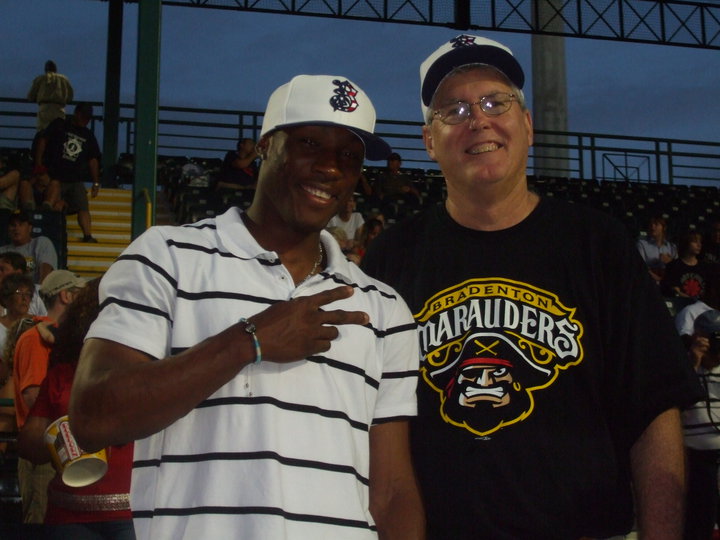
I realized something rather strange last night. I went up to Bradenton to meet the new crop of Bradenton Marauders at a special event at Desoto Square Mall. All in all we have a group of nice kids to be proud of this year. Most were promoted from Low A West Virginia Power and some from the short season State College Spikes. Seven (including five pitchers) are returning from last year's Marauders.

As I talked with some of these guys I felt strange because they weren't "the" Marauders - kids like Qunicy Latimore or Brock Holt or Jeremy Ferrell or Eric Fryer, all of whom were promoted to AA level Altoona Curve this year. I guess its because of the familiarity that developed cheering those guys on through 68 home games and 6 away games and the Division championship series. I miss that team. All last summer fellow Marauder fans and I would debate and discuss who on the 2010 team should be promoted to AA or AAA level or why they hadn't been promoted already. Now that exactly what we discussed has come true for them, I find myself selfishly wishing it hadn't happened.

I talked with Joel,the "voice" of the Marauders who announces all their games and who maintains the blog "Its Deep and Might Not Be Playable" about the Marauders. He told me that this year's Marauders hit more home runs at West Virginia last year than "we" did. "We" being the 2010 Marauders. Maybe Joel was feeling the same way.

It will probably get better in a few weeks when seeing Benji Gonzalez at shortstop this year is as natural as seeing Brock Holt there last year, or watching outfielder Evan Chambers knock balls out of the park becomes as common place as watching Quincy Latimore do it 19 times last summer.

Right now, however, its weird not having "our" Marauders around any longer.

Friday, April 1, 2011

Moving On Up


Anyone who was alive and functional in the mid-1970s has to remember the hilarious television sit com "Movin on Up" about George Jefferson and his wife who moved from a lesser part of New York City to Manhattan after husband George made it big in the laundry business. This video and its tune should bring back memories to many who may have forgotten this great show that helped break down some of the stereotypes about people who are not as well off who could "make it" and enjoy the American dream.

As strange as it may seem I was humming this song this afternoon at Pirate City when I watched inter-squad games between the 2011 version of the Class AAA Indianapolis Indians and the Class AA version of the Altoona Curve. While the Indians -v- Curve game was being played out on one field the 2011 version of the Class High A Bradenton Marauders were playing the 2011 version of the Class Low A West Virginia Power. It was a minor league baseball lovers dream come true.

On my arrival I saw my friend Dave Howard who was the 2010 Bradenton Marauders hitting coach. Unfortunately for the Marauders Dave will be with the West Virginia Power in 2011. Maybe that's good in the long run because Dave will be able to help some of the Power make it to the Marauders this year. I congratulated Dave on his move to West Virginia and told him to keep track of opponents needing heckling this summer because I was coming up to watch his guys play and needed to know who to focus on. Dave laughed and said "I feel sorry for them." He should.

I found the field where the AA - v - AAA game was being played and took up a position behind home plate (is there any other place to watch a ball game?).

Almost immediately 2010 Marauder starting pitcher Brian Leach walked up behind me. I had not seen Brian since the last game of the 2010 championship series. I came to really enjoy talking with him last year. On top of being an exceptionally nice and kind person he's also a great starting pitcher. I asked Brian if he was going to start in Altoona where he belongs this year. He said that the Pirates had started to convert him to a bullpen pitcher and he thought he might begin the year in Bradenton and then move on up to Altoona later. He's good enough to start the season in Altoona and maybe even Indianapolis. We'll get him there by the end of the season.

The AAA - v - AA game began not long after 10:00 a.m. and the starting line up for the Curve (or who I assume will be the Curve) included 2010 Bradenton Marauder stars and favorites Brock Holt at second base. Brock is without doubt the best infield prospect the Pirates have in their minor league system. He suffered a meniscus tear in early June 2010 that sidelined him for the remainder of the season. One of my unknown claims to fame is that both Brock and I had surgery to repair a meniscal tear on the same day - June 24, 2010. Unfortunately Brock's injury took longer to heal than mine did otherwise he would have been in Altoona by the end of the year. Brock started off the game with a single, then stole second and eventually scored. His next time up he scored again. Ronny Cedeno, the current starting Pirates shortstop, better keep an eye over his shoulder because a much better short stop named Brock is going to be on his tail very soon.

Also starting today was my second most favorite 2010 Marauder catcher Eric Fryer. Eric is an incredibly nice kid. He's very effective and most importantly very humble. The Marauders had some tragedy in 2010 and one of the tragedies was the back to back loss of Tony Sanchez to a pitched baseball in the face followed a couple nights later by Eric taking one in almost the same part of his face as Tony. Everyone and their brother raves about how great Tony Sanchez is in part because of his top ranking in the 2009 draft and the amount of money he received as a signing bonus. After watching these two guys play last year I'm convinced that Eric is a much better catcher defensively than Sanchez. He will prove me right when he gets further up the line.

Along with Eric was the incomparable Quincy Latimore ("Q" or "the Double Deuce") freshly back from a winter of playing with the Adelaide Bite in the Australian Baseball League, mate. Q was famous in 2010 for a number of reasons including hitting a home run his first at bat as a Marauder and later in the season setting a Florida State League record with 100 runs batted in. True to form today Q hit a home run over the left field fence. I have the ball he hit today and got him to sign it for me. I talked with Q for a bit while he was on the bench and wished him well. Anyone who cares about the Pirates will be paying attention to this kid in a couple years when he's roaming right field at PNC Park.

The Double Deuce Doing What He Does Best

Another of my favorites, Starling Marte, started for the AA team in Center Field. Starling is a product of la Republica Dominicana and an all around great kid. He hurt a hamate bone in his right hand in the middle of the 2010 season otherwise Starling would be much higher up than the AA Altoona Curve in 2011. In fact several prospect books I have read project him to be in the outfield for the Pirates in 2014 with no mention of Pedro Alvarez. Right on cue today Starling walloped a ball into deep right center field and turned it into a triple. It won't be long before Starling is in the Show.

My friends Starling Marte and fellow Marauder fan Patrick Sullivan at McKechnie Field not long after Starling hurt his hand in 2010

Another 2010 Marauder starting today was third baseman Jeremy Ferrell. Jeremy is a third-generation professoinal baseball player; His dad is currently the manager of the Toronto Blue Jays. Like many other excellent 2010 Marauders Jeremy had injury problems. His involved an infection that turned septic and kept him out for much of the rest of the season. When I describe Jeremy to people I tell them that he is "Evan Longoria quality" as a third baseman. He needs to work a bit on his hitting, especially breaking balls, but once he does he'll be headed to the Show in a matter of months. His next stop will be Indianapolis by the end of 2011. I expect to see him in the hot seat for the Pirates in 2014.

Although five of the 2010 Marauders started for the Altoona Curve, catcher Tony Sanchez started for the AAA Indianapolis Indians.
Tony is a very nice person, quite humble in fact, and quite intelligent. He went through Boston College with a 4.0 for christ's sake! He played for the Marauders in 2010 until in early June when he was hit in the left eye by a pitched ball. He was out for the rest of the season. Tony was a top draft pick for the Pirates in 2009 and is on a meteoric rise to the Show. Given what I saw in spring trainign this year I would not be surprised to see Tony in Pittsburgh by the end of the 2011 season. If the Pirates are smart they will take Eric Fryer along with them.

So, among 18 players on the field this morning for the AA and AAA level teams 6 of them or 1/3 were 2010 Bradenton Marauders. Just like George Jefferson in that sit come from long ago, a bunch of our kids are "movin on up."

While the Curve were playing (and beating I might add) the Indianapolis Indians, the 2011 Bradenton Marauders were playing the 2011 West Virginia Power on an adjacent field. I spent some time watching the new Marauders but only recognized Calvin "The Bus" Anderson, the 2010 Marauder first baseman. Calvin earned his nickname last summer the night that he hit a ball over the scoreboard in center field, over the building beyond it with the ball eventually crashing into a bus in the parking lot behind the building. It was a moniker well earned. Despite his 6'7" frame Calvin is a bit of an enigma. He would be dangerous if he could learn to hit a curve ball. Watching him is almost like watching the character "Cerano" in the movie "Major League". Cerano once in an interview said "I hit the fast ball very much. I hit the curve ball not so much." Calvin has the same affliction. Hopefully another year in Bradenton will help him learn how to hit the curve ball very much.

Calvin "The Bus" Anderson at First Base
When I wasn't watching the 2010 Marauders game I was trying to pay attention to the 2011 crop. Other than Calvin they were all names with which I was not familiar. However on the first day of the 2010 season I had never heard of Quincy Latimore or Brock Holt either.

I'm sure that a month from now when we have all cheered for, and heckled for, and bought a few beers for these new Marauders, we will be just as proud of them as we are of last year's crop that seems to be rapidly moving on up to the Show. I just hope they remember us in a couple years when 40,000 fans are screaming their lungs out for these kids we all put so much energy into accepting and appreciating like they are our own.

And I guess if you look at it prgamatically they are our own.