Monday, July 23, 2012

Florida's 67 Counties

It's all Bob Ake's fault.
Bob was a Physical Chemistry professor at Old Dominion University in Norfolk, Virginia, when he took a sabbatical and moved to Madison, Wisconsin for the 1976-1977 school year. His purpose in coming to the U was to do research on some topic in Physical Chemistry that I will never understand and. Just as important although not a stated purpose of the sabbatical was to see as many species of birds in Wisconsin as possible in the year he would reside in Madison.
In May 1977 Bob traveled to western Wisconsin to look for Red-necked Grebe that was nesting on a large Federally-owned Waterfowl Production Area in St. Croix County. After finding the bird he stopped by my home in River Falls to report in and to say hi to my now-former wife and me. At about 10:00 p.m. Bob said he was leaving for the drive back to Madison. He reckoned that it would be a four hour drive if he followed Interstate 94 south. He then added "If I take Highway 35 south to LaCrosse and cut across from there it will take me six hours but I'll add five counties to my county list."
At the mention of the word "list" my ears perked up and I asked about his county list. Bob explained that no matter where he lives or travels he keeps a list of all the counties he has visited. It was something to do and a great way to learn more about wherever he was.
Bob then asked me "Don't you keep a county list"?
I answered, "Well, I do now."
There are 3,076 counties or parishes in the lower 48 states and Hawaii. (Alaska has 17 "burroughs" but some of them are the size of Montana and its difficult to wrap my head around the concept of a county the size of the Big Sky state). I set a goal long ago to one day have visited each of the 3,076 counties and parishes.
The distribution of counties and parishes in the lower 48 states
It took 23 years of traveling from one end of the country to the other but finally on May 29, 2000, at 4:04 p.m. Pacific time I entered Deschutes County Oregon. It was number 3,076. The last county.
On moving to Florida in March 2008 I decided to retrace my steps around to all of its 67 counties. One purpose of doing so was to acquaint myself with my new home state. I also wanted to start a list of the birds I had seen in each of the 67 counties. In 2010 when I attempted to see as many species of birds inside the boundaries of Florida in a calendar year I visited each of the state's counties a minimum of five times in 365 days.
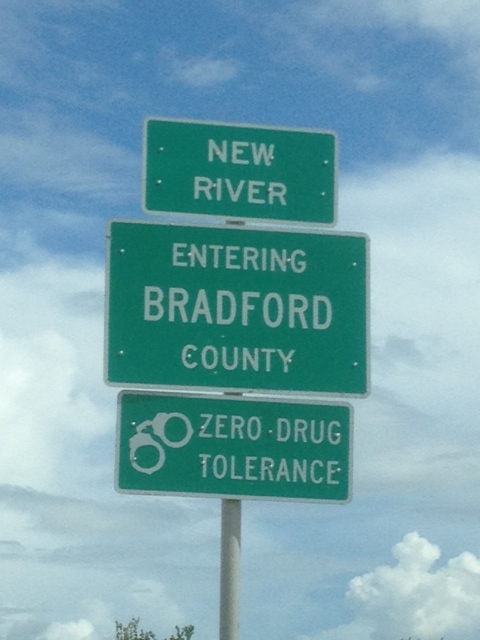
Eventually people started to question me when I told stories about "collecting" counties. Mainly the questions revolved around "proof" that I had actually been in each county. After giving it some thought I decided that one way to provide that proof was to take a picture of a county entrance sign for each of the counties. And that is what this post is all about.
This past weekend I drove over to the east coast to get pictures of the three counties for which I did not have a county entrance sign to finish this quest. A former love interest of mine once said that I was "childish" for wanting to photograph county signs. I would counter with the words from a Jimmy Buffett song that go "Its the child in us we really value." Instead of letting her words influence me I pushed on and finished the quest. Luckily like a bad dream she is history and I finished doing what I set out to accomplish.
I have learned a great deal about Florida in this process. I've seen great natural resources from the marshes of Gulf Islands National Seashore near Pensacola (Escambia County) to the expansive prairies of Okeechobee County, to the West Indian hardwood hammocks of the lower Keys (Monroe County). I've also learned a great deal about the disparities that exist in the living conditions of Floridians. For instance Palm Beach County (which ranks first) has a per capita income of $44,518 to beleaguered Union County (which ranks last) with a per capita income of $14,535.
I have also learned a lot about the sometimes crazed people who call Florida home. Someone told me when I moved to the state that I should live north of Interstate 4 (which bisects the state from Tampa to Daytona Beach). Their reasoning was that "the further north you go in Florida the further south you get." And its a very accurate assessment. The Panhandle, otherwise known as the "Redneck Riviera" contains some beautiful landscapes but people there are still fighting the "war of northern aggression" just like they do in Georgia and Alabama each day. The Redneck Riviera also votes heavily Republican which is another reason to travel through it quickly, and its the heart of the bible-thumper belt. Curiously if you look at the list of per capita income by county the bulk of the counties at the lower end of the scale are on the Redneck Riviera.
Yesterday when I obtained a digital image of the entrance sign for Seminole County, thereby fulfilling this quest I decided to post a picture of each county entrance sign as "evidence" that I had been there. Some of the images are very crisp and clear while others definitely need to be replaced in the future. For instance, the Clay County sign was photographed in a pouring rainstorm and a better one needs to be taken to replace it. Maybe that will be the next quest - to obtain even better pictures of some county signs than the ones I have here. Its a really good thing that person from my past is no longer around. Doing this again might likely put her over the edge.
With the postings below I include a small comment about each of the counties. I hope you find some value in this posting. If not, c'est le vie.

Alachua County - home of Gainesville and the University of Florida Gators
Baker County - home of the Olustee Battlefield State Park and also some of the finest and most extensive pine forest remaining in north Florida. If you want to hear Bachman's Sparrows on territory this is an excellent place to look and listen.
Bay County - Home of Panama City and more importantly where the Margaritaville Cafe Panama City Beach is located.
Bradford County - Another of the poorer counties in the state
Brevard County - On the "Space Coast" it is home to the Kennedy Space Center, the Merritt Island National Wildlife Refuge, and the Brevard County Manatees minor league baseball team. Its one of the best counties for birding in Florida.
Broward County - Home of Fort Lauderdale and rampant development of wild areas to accommodate the retiring hordes of New Yorkers who are trying to escape New York winters on a permanent basis. Its also where I met, and drank a beer with, Jimmy Buffett.
Calhoun County - In the Panhandle just west of Tallahassee, I think Calhoun County has more Chuck-wills-widows singing during the nesting season than anywhere else I've been in the state.
Charlotte County - On the west coast, Charlotte County is where Hurricane Charlie came roaring ashore in 2004. Its also home to the Charlotte Stone Crabs, the High A minor league affiliate of the Tampa Bay Rays and the spring training home of the Rays.
Citrus County - Located two hours north of Tampa, Citrus is one of the smallest counties in the state. You definitely don't want to blink or you'll miss it.
Clay County - Much of northern Clay County appears to be a bedroom community for the extensive Jacksonville metropolitan area.
Collier County - Home of Naples, the city with the highest density of millionaires in the United States. More than 60 percent of Collier County is registered Republican. I scrub vigorously in the shower immediately after leaving Collier County.
Columbia County - Sprawling Columbia County is bordered by the Suwannee River and is the home of the Stephen Foster State Park. Curiously Stephen Foster made the Suwannee River famous in his song, but never once saw the river in real life! What a disappointment it was to learn that fact.
DeSoto County - This is a county where farming and ranching are still big business. Its a pleasure to travel through and around DeSoto County and not see offensive condo developments everywhere you turn.
Dixie County - This county borders Florida's "Nature Coast" in the Big Bend region of the state. If you want to get a feel for what "Old Florida" was like head out for little places like Steinhatchee on the Gulf of Mexico. You'll likely find yourself not ever wanting to leave.
Duval County - The boundaries of this county are exactly the same as the boundaries of the city of Jacksonville which makes Jacksonville the largest city, by area, in the state. Duval County offers some excellent birding, especially at the several Florida State Parks on the Atlantic coast.
Escambia County - This is the home of Pensacola and also home to some of the best birding in Florida. During my 2010 Big Year I made 14 roundtrips to Escambia County chasing after rare (for Florida) birds that had been found there. Its 519 miles one way from Sarasota to Pensacola. Escambia County is also home to Jimmy Buffett's first hotel - the Margaritaville Beach Hotel. Its also where, according to the song, Frank and Lola went on their second honeymoon and were almost run over by the life guards jeep.
Flagler County - Located on the Atlantic Coast just north of Daytona Beach, Flagler County is home to Bulow Plantation Ruins State Park (and several others), a place that makes me feel like I'm seeing Florida like it was when Ponce de Leon stepped ashore ages ago.
Franklin County - Located on the Redneck Riviera, Franklin County is one of my most favorite places to visit in this state. Its probably a combination of St. Vincent National Wildlife Refuge, St. George Island State Park being there along with much of the county inside the boundaries of the Apalachicola National Forest. The city of Apalachicola is one of the finest examples of "Old Florida" remaining in this state. I hope it always stays that way.
Gadsden County - Located just west of Tallahassee, Gadsden County is home to Torreya State Park and to very few people. I knew there was a reason I liked going there.
Gilchrist County - Gilchrist County is, well, Gilchrist County. I usually pass through it headed to someplace more interesting and there are a lot of places more interesting.
Glades County - Located straight west of Lake Okeechobee, Glades County is almost entirely made up of Everglades habitats or, more commonly, former Everglades wetlands that have been converted to sugar cane. Endless sugar cane. What was it that Jimmy Buffett sang about "the sugar barons screwing up the glades"?
Gulf County - Another Panhandle favorite of mine, you can visit the site where the Florida Constitution was hammered out (in Port St. Joe) and also lounge around on the beautiful beaches at St. Joseph Peninsula State Park, all in the same day.
Hamilton County - The first county anyone traveling to Florida on I-75 enters is Hamilton County. In winter there always seems to be a flock or two of Sandhill Cranes flying around in the late afternoon here. You can never go wrong when you're surrounded by Sandhill Cranes.
Hardee County - Stuck out in the middle of nowhere straight east of Sarasota County, there is very little if anything going on in Hardee County. And I think that is why I enjoy going there so often.
Hendry County - Another Everglades County and a very good one for birding, Hendry County seems to be home to more alligators than humans and that is always a good thing.
Hernando County - About an hour north of Tampa and bordering the Gulf of Mexico, Hernando County seems to be one of the more likely counties to experience nasty summer time thunderstorms than most others on this side of the state.
Highlands County - Located on the Lake Wales Ridge, the ancient shoreline of Florida during the last glacial period, Highlands County is home to some of the rarest and most unique plant species in the state. There are also a lot of Florida Scrub Jays here. Last but not least its home to Highlands Hammock State Park that harbors some of the most beautiful forest in Florida. I'm almost brought to tears at times in this park because of its beauty.
Hillsborough County - Tampa dominates the landscape of this county. Despite the crush of human habitation there are still many wonderful wild areas here to explore like Hillsborough River State Park.
Holmes County - Abutting Alabama and located in the Panhandle, Holmes County is one of the counties with which I am least familiar. Falling Waters State Park is hear near Chipley, providing some of the most enjoyable topography in the state. Its also the only place I have seen a Copperhead snake in Florida. So, I guess there are a couple things positive about it.
Indian River County - While doing wetland field work in Indian River County in 1999, we used 18 month old aerial imagery to orient ourselves. Only problem was that there had been so much development near Vero Beach that the 18 month old imagery was practically useless to us. It will only get worse.
Jackson County - Located where Alabama, Georgia and Florida all meet, and where the Chattahoochee River turns into the Apalachicola River when it leaves Georgia and enters Florida.
Jefferson County - The only Panhandle county that extends from Georgia to the Gulf of Mexico, Jefferson County supports some of the most spectacular lowland forested wetlands in the state. If there is still an Ivory-billed Woodpecker or two hanging around I wouldn't be surprised if it turned up in Jefferson County.
Lafayette County - Located in the center of the "springs" region of Florida Lafayette County is home to at least three state parks. Also, the only flock of sheep I have ever seen in this state lives here. So does a huge guard dog.
Lake County - Located north of Orlando in central Florida, Lake County is home to a development city known as "The Villages." The Villages is the epicenter of the Tea Bag Anarchy Party in Florida and about the only place our criminal governor can go and speak to cheering crowds. I usually pass through Lake County as quickly as legally possible.
Lee County - Located in southwest Florida on the coast, Lee County is home to Fort Myers, the Corkscrew Swamp Sanctuary, Lovers Key State Park, Sanibel Island, the Fort Myers Miracle minor league baseball team and to not one but two Doc Ford's Sanibel Rhum Bars and Grills. Need I say more?
Leon County - This is the home of Tallahassee and Florida State University making it an island of liberal progressive thought in an ocean of rednecked Rush Limbaugh fans. A few years ago I stopped in a restaurant in Tallahassee for lunch. Knowing full well that the Florida State University (the Seminoles) and the University of Florida (the Gators) hate the thought of each other, I asked my waitress "Is Tallahassee where the Gators are from?" A hushed silence came over the restaurant as everyone turned to look at me. The waitress almost screamed at me "No we are the SEMINOLES" I replied with "Well where are the Gators from then? I thought they were in Tallahassee' Again, almost screaming, she barked at me "NO THEY ARE IN GAINESVILLE!" Not wanting to press my luck any more I stopped asking questions and left the restaurant.
Levy County - Located in the Big Bend region of Florida, this is where the Suwannee River ends its journey across north Florida and empties into the ocean. Its also home to Cedar Key, about the only city left in the state that mimics how Key West likely was in the 1930s. Make sure you check out the Jimmy Buffett room at the Island Bed and Breakfast in downtown Cedar Key.
Liberty County - You don't need to wrap yourself in the flag when you slide into Liberty County but it probably wouldn't hurt to do so. Despite its politics this is another favorite county in the Panhandle because of the presence of extensive areas of pine forest and very few people. I want it to always be that way.
Madison County - Located in north central Florida and bisected by Interstate 10, Madison County is home to the Deer Park water bottling company. Its also one of only about three counties in Florida where you can regularly find White-breasted Nuthatch.
Manatee County - Any county named after an endangered species of marine mammal is an ok county in my book. Its also where I currently reside so I might be a tad biased.
Marion County - This is where Ocala is located. It is also the epicenter of Florida's horse county.
Martin County - Hobe Sound National Wildlife Refuge and Jonathan Dickinson State Park are two of the best reasons to visit Martin County on the southeast coast of Florida. My old friend Nathaniel Reed, former Assistant Secretary of the Department of the Interior, resides in Martin County from which he concocts all sort of ideas about how to protect what little remains of wild Florida.
Miami - Dade County. My most favorite airport in the world, Miami International, exists here among the rat race of southeast Florida. Its my most favorite because I can go almost anywhere in the tropics that I want to go, and I can do so nonstop from MIA. Its also where, according to a Jimmy Buffett song, everybody has a cousin.
Monroe County - Except for a portion of the county on the mainland of Everglades National Park (and therefore uninhabited by humans) Monroe County is the Keys. What more needs to be said?
Nassau County - The first Florida county you encounter as you travel south from Georgia on Interstate 95. It was the first Florida county I ever visited and where I heard and then saw the first Bachman's Sparrow of my life.
Okaloosa County - This county is best known for Eglin Air Force base and for the crush of tourists at the beaches of Destin. Coastal development has been rampant here and there are few areas in coastal Florida more in need of a great Category 6 (never been recorded before) undeveloper hurricane to sit off shore for about 48 hours and revert the coast to the way it was intended to be.
Okeechobee County - Whenever I get the urge to feel like I'm back on the prairies of Nebraska or North Dakota I head over to Okeechobee County. Its home to Kissimmee Prairie State Park and to some of the finest native grassland habitat remaining in Florida. I hope it stays that way.
Orange County - This is Orlando. Enough said? I detest driving in Orlando. I would prefer to eat broken glass for an hour rather than drive through Rat World Central. At least there is a Margaritaville Cafe at Universal Orlando. Next.
Osceola County - Located southeast of Orlando Osceola County has some extensive areas of native grassland remaining. It is also the spring training home of the Houston Astros and the Atlanta Braves so it can't be all bad.
Palm Beach County - This is the richest county in Florida. Its also where Rush Limbaugh lives and is allowed to slither around unchaperoned. I generally avoid Palm Beach County at all costs.
Pasco County - Located just north of Tampa/St. Pete, Pasco County is home to funky little Tarpon Springs. If you want to learn about the sponging industry and have some great Greek food in the process go no further than Pasco County.
Pinellas County - This is where St. Petersburg and Clearwater are located. Pinellas County has the distinction of being the first (and so are only but that will change) county in the state that has been completely developed. Only small shards of what once was still remain here. Pinellas County is how most of the rest of Florida will look in a few short years. I'm glad I will be dead by the time that happens so I don't have to witness it.
Polk County - Rumor has it that there is more inbreeding among humans in Polk County that any where else in the state.
Putnam County - Located just outside of the Jacksonville metro region Putnam County is a pleasant place. Ravine Gardens State Park in Palatka is a great place to spend a few hours.
Santa Rosa County - Located directly east of Escambia County, Santa Rosa is a long drive to get to from Sarasota.
Sarasota County - Good old beautiful Sarasota County. What more can I say? Among other things Myakka River State Park, the largest state park in the system is here. So also is Oscar Scherer State Park with its population of Florida Scrub-Jays and with one of the largest Eastern Diamondback Rattlesnakes I've ever seen. Jerry Seinfeld lives here and Stephen King has a winter home here. Its a great place to people watch and St. Armand's Circle is the place to do that.
Seminole County - Among the smallest counties in Florida and right at the edge of the Ratworld/Orlando metropolitan circus Seminole County is at and near the headwaters of the St. John's River one of the most important natural waterways in the state. Seminole County also markets itself as "Florida's Natural Choice" Given the crush of humanity there I hope what little natural remains is able to exist for a few more years.
Seminole County - Florida's Natural Choice
St. John's County - Located in the northeast corner of Florida along the Atlantic Coast, St. John's County is home to St. Augustine, the oldest city in the United States.
St Lucie County - Home to Fort Pierce Inlet State Park and several other, smaller, state parks, this is one of my most favorite places to visit on Florida's Atlantic coast.
Sumter County - The battered sign says it all.
Suwannee County - Not surprisingly the world famous Suwannee River dominates the landscape here. I'd love to paddle a kayak the entire length of the Suwannee River some day.
Taylor County - Another of the Big Bend Region counties, Taylor County is home to the Aucilla River one of the most beautiful places in this state. Extensive estuarine emergent (salt marsh) wetlands occupy the landscape where the river meets the sea. Its one of the most tranquil places I have found in Florida.
Union County - The smallest and poorest county in Florida, Union County is home to the Florida State Prison at Raiford.
Volusia County - This is where Daytona Beach and its famous "Bike Week" are located. And Daytona Beach is where the Ocean Deck bar is located. It was in the Ocean Deck where Jimmy Buffett received the inspiration for his song "Fins" about a girl who walked into a bar alone and was immediately hit on by four "landsharks." Fins is the high point of every Buffett concert - when the child in all of us comes rushing out. And it all happened because of a girl in a bar in Volusia County.
Wakulla County - St. Mark's National Wildlife Refuge protects a large expanse of coastal wetland and forest habitat in Wakulla County. San Marcos de Apalache State Park and Wakulla Springs State Park are also located here. Its one of my most favorite birding counties in the state. An Eastern Diamondback Rattlesnake nearly 5 feet long and as thick as my forearm rattled at me from under this road sign the night before I took this picture. Needless to say I gave him a huge wide berth the day before.
Walton County - Another of the "way out west" counties, Walton County is home to several excellent beach state parks including Grayton Beach State Park.
Washington County - Stuck in the middle of nowhere in the western Panhandle there's not really much to say about Washington County. I've seen fewer species of birds in Washington County than any other Florida county. Maybe there's a reason for that?

Friday, December 23, 2011

When Debt Collectors Have the Wrong Address

In the hilarious movie Ruthless People there is a scene in which Danny DiVito gets a phone call that is a wrong number. After listening politely to the caller, a smirk comes over DiVito's face as he says "I'm sorry. She's busy right now. She has my cock in her mouth." DiVito then slams down the phone and with a smile on his faces says "I love wrong numbers."

If it was possible to do the same with mail being sent from debt collectors to someone who lived at my address before me I would gladly do it. Unfortunately I do not know the former resident's current address (or do the bill collectors) or I would do it.

Since moving to my current residence on February 28, 2011, my mail box has been regularly cluttered with mail for a Laura Riley who obviously used to live at my address. There were lots of letters and they came from all manner of collection agencies. At first I would write "not at this address" across the front of the envelope and drop it back in the mailbox hoping the post office would return it to the sender and the sender would get the hint.

The senders kept sending her letters. Finally in July I started opening her letters to see what this volume of mail was all about. I would read the letters and then toss them in the recycling bin. Certainly, I thought, Ms. Riley must be an adult to have been able to rent a townhouse. And certainly as an adult she had the common sense to file a mail forwarding request with the US Postal Service. However as time wore on it was apparent that being efficient and responsible were not in Ms. Riley's vocabulary.

Today, for the umpteenth time, a letter appeared for Ms. Riley from ARA a bill collector in Villa Park, Illinois. Finally having reached the limit of wanting to deal with Mr. Riley's mail any longer I decided to fight back. From now on when a bill collector letter comes for her I'm calling the company and telling them she's not here. Ms. Riley is incapable of being responsible for her actions so I'll take care of some of those responsibilities for her. I called the company twice and then wrote them a letter.

When I contacted the company by phone I was put through to the "Collections Manager" (sounds like someone at a museum). I left that person a voice mail begging them to find Ms Riley and stop filling my mail box with her stuff. I then was connected with the collections agent who sent her the letter I received today. When I called her extension I was put through to voice mail and I left essentially the same message with that person as I did with the collections manager.

Then I decided, as a follow up to the voice mails, to send a letter to ARA and the collections agent regarding Ms. Riley and her inability to get her mail forwarded. That letter follows:
December 23, 2011

Shelly XXXXXX
ARA Incorporated
Box 5022
Villa Park, Illinois 60181

Re: ARA File Number 332272

Dear Ms. XXXXXX

I am writing as a follow up to my phone call (left on your voice mail) today regarding both the referenced ARA file number and the person, Laura Riley, who is responsible for this account.

For the record – LAURA RILEY DOES NOT RESIDE AT (my address)

I have no idea who this person is but since I moved to this address on February 28, 2011, my mail box has been cluttered weekly with letters from your company and other collection agencies (and a couple of state tax revenue departments) regarding Ms. Riley’s various delinquencies.

I am writing to not only ask and request but beg you to stop sending collection information to Ms. Riley at this address because she does not live here. I have no idea where she is – perhaps you could do a Google.com search on her name. Check with the IRS for her current address. Send up smoke signals. Do whatever it takes to find her but PLEASE stop sending mail to her at this address. She is apparently an adult and should be responsible enough to have filed a forwarding information card with the US Postal Service so she can get her mail at the proper address. This is all her problem, not mine. I’m just fed up with getting her mail.

Thanks for your attention to this request. I hope you find her and I hope you get your funds from her. Perhaps when you do you can give her a handful of mail forwarding cards so she can get her mail at her address not mine.

Attachment – Incoming from ARA Inc
Its unfortunate that my phone number is not the same as the one Ms Riley had when she lived in my house. If it was and I started getting phone calls for her from collection agencies I think I'd recount verbatim what Danny DiVito said to his wrong number in that movie :)

Thursday, December 15, 2011

The Southernmost Point in Africa

Geographical extremes capture the imagination. From ancient mariners to contemporary mankind, the quest has always been to reach the poles, sail around the tips of continents, conquer the highest peaks and dive to the ultimate depths...South African National Parks
My first job with the US Fish and Wildlife Service was as an ascertainment biologist in our regional office in Minneapolis. There were four of us whose responsibility it was to review lands proposed to the Service for acquisition and inclusion in the National Wildlife Refuge system. We did this work in Wisconsin, Michigan, Illinois, Indiana, Ohio, and that state just west of Wisconsin whose name begins with an M.

After reviewing background information on the lands and doing site visits we prepared reports for submission to Washington DC justifying (or not) the preservation of those lands. Our reports became known as the "superlative" reports because in them we used words like "most", "fewest", "biggest" or "best" or "last" or the massively overused phrase "at a biological crossroads" between the "southernmost" and the "northernmost" or "easternmost" or "westernmost" points in the range of a species or a habitat.

It was partly because of our responsibilities in that job (and partly because I'm anal-retentive) that I developed an interest in visiting places or seeing species that are at the edge or the limit of their range. For example, a few years ago I made it a point to fly to Ushuaia, Argentina in Tierra del Fuego because its the southernmost city and has the southernmost airport in the world. Similarly there is Barrow Alaska with the northernmost airport in the world. In 2000, I chartered a plane and flew to Rose Atoll National Wildlife Refuge in American Samoa - it is not only the southernmost refuge in the system but also the southernmost point of land controlled by the United States.

One spring I walked to the tip of Point Pelee near Leamington Ontario so I could urinate on the southernmost point in continental Canada.
Point Pelee, Ontario - the southernmost point in continental Canada


When you land at the Hilo airport on the Big Island of Hawaii not only is it a new airport for your airport list but its also the easternmost airport in that state.
Hilo Airport - the easternmost airport in Hawaii

And who could forget Port Oxford, Oregon, the westernmost point in the continental United States? Or taking off from the Hobart, Tasmania, airport, the southernmost airport in Australia? Or Key West, Florida, the southernmost city in the continental United States?

One of the many reasons I wanted to visit South Africa was because it is the southernmost country in Africa. And before making this trip I had always been under the misguided assumption that the Cape of Good Hope south of Cape Town was the southernmost point in Africa - its not.
Cape of Good Hope - the southwesternmost point in Africa

When I discovered this little geographic oversight I had to make a change in my trip plans to go to the southernmost point. I was so close there was no alternative.

This information from Wikipedia pretty well describes Cape Agulhas:
Cape Agulhas is the southernmost point in the continent of Africa. It is located at 34°50′00″S 20°00′09.15″E,34°50′00″S 20°00′09.15″E in the Overberg region, 170 kilometres (105 mi) southeast of Cape Town. The cape was named by Portuguese navigators, who called it Cabo das Agulhas — Portuguese for "Cape of Needles" — after noticing that around the year 1500 the direction of magnetic north (and therefore the compass needle) coincided with true north in the region. The cape is within the Cape Agulhas Local Municipality in the Overberg District of the Western Cape province of South Africa. The official dividing line between the Indian and Atlantic oceans is defined by the International Hydrographic Organization to pass through Cape Agulhas.

South of Cape Agulhas the warm Agulhas Current that flows south along the east coast of Africa retroflects back into the Indian Ocean. While retroflecting, it pinches off large ocean eddies (Agulhas rings) that drift into the South Atlantic Ocean and take enormous amounts of heat and salt into the neighboring ocean. This mechanism constitutes one of the key elements in the global conveyor belt circulation of heat and salt.

Unlike its better-known relative, the Cape of Good Hope, Cape Agulhas is relatively unspectacular, consisting of a gradually curving coastline with a rocky beach. A survey marker indicates the location of the cape, which would otherwise be difficult to identify. The waters of the Agulhas Bank off the coast are quite shallow and are renowned as one of the best fishing grounds in South Africa.

The rocks that form Cape Agulhas belong to the Table Mountain Group, often loosely termed the Table Mountain sandstone. They are closely linked to the geological formations that are exposed in the spectacular cliffs of Table Mountain, Cape Point, and the Cape of Good Hope.
I visited Cape Agulhas on September 29, 2011 arriving there in early afternoon after driving over from the penguin colony at Simon's Town. Just like a major tourism attraction in the United States the road signs telling you that you are approaching the area begin 50 miles before you get there. Its no different with Cape Agulhas.

On my arrival I discovered that I had to disagree with some of the words in the Wikipedia description because the snarling, angry ocean crashing relentlessly into the rocks at the Cape made the Cape awfully spectacular.

Geographers have determined (decreed?) that the Cape is the official place where the Indian Ocean meets the Atlantic Ocean. However looking out over the water I couldn't tell where one ocean ended and the other began. Maybe next time?
Where the Indian Ocean and Atlantic Ocean meet

Despite 50 miles of highway signs leading to the Cape, and signs on almost every building in the village proclaiming this to be the southernmost point, and there being a National Park at the Cape, I was the only visitor during my hour at the Cape.
A Cape Wagtail was the "Southernmost" landbird in Africa when I visited the Cape

As I stood at the southernmost point of continental Africa looking south into the fierce spring winds my usual case of incurable wanderlust came over me. I fantasized about being on a ship headed due south from that point. Google Earth told me that it was just 2,400 miles from where I was standing to the first point of "land" on the ice continent of Antarctica. A well-provisioned ship could get me there in five days. Imagine all the cool seabirds I could find in those 2,400 miles. Then came thoughts about all of the explorers who passed through those waters just after everyone realized that the earth isn't flat. And think of the crazy folks who have passed through the "roaring forties" in sailboats as they have tried to circumnavigate the globe. Then I thought about Mark Twain's superb book "Following the Equator" and realized that at some point on his around-the-world journey Mark Twain had to have passed directly south of where I stood.

There was so much history in front of me that I wanted to learn and so much geography that I wanted to experience and so much biology swimming and flying around somewhere south of where I stood. And here I had gone and planned only an afternoon out of my five week trip to be at Cape Agulhas. Before going there I thought it was just going to be another bunch of rocks by the ocean where tourists would take pictures and Aunt Edna would say to Uncle George "did you see that big wave, George?" and then forget that they had even been at the Cape the following day. One of the first things you learn when you travel extensively is to always plan more time than you think you'll need for each place you want to visit. I didn't do that with Cape Agulhas and left the Cape feeling I had missed out on something.

There are many other "most's" I would like to see some time. And if you think long and hard and objectively enough almost everyplace could be turned into a "most" of some sort.

Still among all of the "most's" I have already experienced Cape Agulhas, described as "unspectacular" has been the most spectacular most of them all.

I think I need to go back there.

Wednesday, December 7, 2011

Taking Care of Business - JR Richardson Style


Jim Richardson was my plant taxonomy professor while I was in graduate school. It was because of him that I took so many botany courses I should have declared a botany minor. I'm not sure what it was about JR (as we called him) but he made you want to learn everything there was to learn about the natural world.

Having received his PhD in plant taxonomy from the University of Kansas JR had more than his share of stories to tell. Like the time in graduate school when he was out in western Kansas some place where he found a particularly robust specimen of Cannabis sativa that he dutifully collected for the University of Kansas herbarium. As he was preparing the specimen for the collection a local country deputy sheriff came along to check out what JR was doing and while looking around found the pot plant. Asking JR the story he quickly explained that he was a grad student at the University of Kansas and that if the deputy would just call his major professor back in Manhattan the entire thing could be cleared up.

There was only one problem. When JR's major professor was called he denied any and all knowledge of JR -- acted like he had never heard of him - and let Jim simmer in a western Kansas jail overnight. Of course the next day his major professor drove out to western Kansas and bailed Jim out. The experience seemed to set the mood for how JR loved to jerk around this own students later on.

When we were were in graduate school there was an unwritten rule that all of his students were to check his office door on Friday afternoons for instructions on what was likely to happen later that night. JR used to hold attendance required no credit "seminars" at "Bo's N Mine" a popular downtown watering hole. If the sign on JRs door said "Takin Care of Business at Bo's" on Friday afternoon you know that your liver would be screaming for mercy in the morning.

Jim's favorite libation was rum and coke and he drank it copiously. In fact he would gauge the severity of his morning after hangover by how many rum and coke swizzel sticks he had in his pocket the next morning. To the best of our recollection the best he ever did was have 23 of them in his pocket the next morning.

Its because of those nights and all the fun we had with him that every time I hear this fantastic Bachman Turner Overdrive song "Takin Care of Business" I think about JR and wonder what sort of mischief his now 70 year old body is causing.


Anyone who remembers the hilarious movie "American Graffiti" remembers the hilarious scene where Richard Dryfus is required, as part of his initiation into a street gang, is required to hook up the axel of a police car to a piece of chain. Then the gang drives by the cops making the latter give chase. When they do the chain reaches the end of its limit and it pulls the rear axel off the car. This was all done in fun for a movie. JR did it for real as a kid in his southern Illinois hometown. When he told that story he became my instant hero.

Despite all of the craziness JR taught me (by the way my oldest daughter's name is Jennifer Rebecca - notice any similarity in her initials and his) he also taught me some of life's most important lessons.

I used to wax poetic about almost everything Aldo Leopold ever said about the environment and its protection. To me Leopold was god. However JR would regularly stop me short when I was waxing poetic and say, simply, "Leopold is full of shit. What do you think of that?" I din't think much of it and an argument would ensure and after the argument I saw where JR was trying to lead me.

Then there was the time I did the oral defense of my Master's Thesis. There were five official members of my committee. JR showed up for the defense solely to harass me. My research was on the nesting ecology of common grackles and mourning doves nesting near the reactor of a nuclear generating plant. During my 2 1/2 hour defense I was required to answer any question posed by any member of the commmittee including JR. About 2 hours into this grueling experience JR asked me, kindly, to explain "why is the dove the international bird of peace?"

I didn't have a clue but I wasn't going to let him know that. Instead I went off on some tangent talking about their soft cooing voice and peaceful feathers and with each word I dug my hole deeper. Finally after what seemed like a day JR yelled at me "STOP". I stopped. He looked at me and said "you don't know the answer do you?" I looked back and said "I don't have a clue what the answer is." JR snickered and said "That's all I wanted to know."

Major life lesson. If you dont know the answer dont be afraid to admit it. You will look smarter because you are being smarter by admitting it up front.

I haven't been in touch with JR in a number of years. The last I knew he was retired and living near Alamagordo New Mexico where he was living out his life fantasy of being some sort of a cowboy.

He probably doesn't remember those "Taking Care of Business" directives on his office wall long ago but I certainly do. And even after nearly 40 years have passed I'm glad I knew him, glad he taught me how to be a biologist, and how he taught me the real meaning of takin care of business even if its not in a song by BTO.

Friday, December 2, 2011

"My" Sandhill Cranes


Our ability to perceive quality in nature begins, as in art, with the pretty. It expands through successive stages of the beautiful to values as yet uncaptured by language. The quality of cranes lies, I think, in this higher gamut, as yet beyond the reach of words.... Aldo Leopold

If I was a betting person I would bet, with some certaintly, that most people with an ecological consciousness and an ecological heart remember the day they saw their first Sandhill Crane. It may have been along a channel of the Platte River in Nebraska or maybe on a National Wildlife Refuge in New Mexico, or maybe along side the road to Disney World in Orlando. However no matter where it was, if you were aware of what you were seeing it was an experience that will likely follow you to your grave.

For me it was a cold early April morning in 1968. I had just recently earned my driver's license (after failing the parallel parking test three times) and decided that it was time to take off exploring. The Crex Meadows Wildlife Management Area near Grantsburg, Wisconsin was about 2 hours from home - far enough to be "away" but close enough to get home to if it turned out to be too far away.

My main reason for traveling to Crex Meadows that day was to see an Osprey, a species of bird that is all too famililar to Floridians today but forty some years ago was almost extinct. Its population was declining at a rapid pace because of chemicals placed in the environment. One of them, DDT, took a special interest in causing the shells of Osprey eggs to thin if there was too much chemical and thin shells meant that adults crushed the eggs and that meant no baby Ospreys. It was a viscous cycle for the Osprey.

For some reason, however, Ospreys were doing fairly well at Crex Meadows and something I read somewhere told me that with a modicum of luck, if I searched long enough I might actually see one of those fishing eating hawks.

I left home early on a Saturday mroning after having milked cows and fed my sheep and taken care of other farm responsibilities. I pointed my old Ford Falcon west on Highway 48 and took off for Crex.

Not long after arriving there I found a large flowage (flowage is a Wisconsin word for reservoir) and in that flowage was a group of dead trees and in one of those dead trees was a pair of Ospreys repairing winter's damage to last year's nest. Despite my anticipation it took me only a few minutes to see an Osprey and begin learning about them - how they flew, how they sang, how one squawked at the other when there was a squabble. In other words I started to learn about what makes an Osprey and Osprey.

About mid morning as I stood on the dike along the edge of the flowage I heard a voice to the south that was unlike any I had ever heard before. It was loud and trumpeting and seemed to fill the entire basin of Crex Meadows. Earlier experience told me that it wasn't a Canada Goose, and it wasn't wimpy enough to be an Eagle, and by now I'd heard enough Osprey's to know it wasn't that species. But what was it?

I searched the southern sky and finally, off in the distance, I saw two small dots that looked at first glance like fighter jets. Their wings were set, there was no motion, they were losing altitude all like a plane would do. Yet they continued to call this primordial call from as high in the sky as I could detect them. I could tell nothing else about them.

All I knew was that they were a long way away from me and were they ever noisy.

Norman Stone was the first manager of the Crex Meadows Wildlife Area. He had been there since the 1940s and probably knew every tree and every grass on his domain by its first and last name. Norm came along in an old beat up pick up truck patrolling the area and probably keeping an eye on the Ospreys when he stopped to ask this 16 year old kid what he was seeing on the marsh. I told him about the Ospreys and what I had seen but more importantly I said I was perplexed by this noise in the sky from what I thought was birds but were too far away to really tell.

"Ah," Norm said, "You get to welcome back the first Sandhill Cranes of the year to Crex Meadows. They should have been here a couple days ago. I guess they just took their time getting up here from Florida." Not knowing a thing about Sandhill Cranes I asked Norm for more information and like a gushing river he filled me with his knowledge of where they come from what they do, how they live how they die and what makes a crane a crane and not some other species. Stone also told me that Sandhill Cranes were a living reminder of primordial America. They were on the landscape long before the American bison showed up and with luck they would be on the landscape many years after humans take leave of the planet.

Stone also told me about a story in a book by a guy named Aldo Leopold that I needed to read. The story was called "A Marshland Elegy" and it was an essay in a book called "A Sand County Almanac." Norm told me "If you want to understand how things were and why they are today like they are today you need to read that book. And when you do you'll know a lot more about Sandhill Cranes in the process."

I stood on that dike for maybe 15 more minutes and listened to Norm tell me about cranes as we watched these birds, that now looked like B-52 bombers, make their final approach to the meadows, where they ultimately heralded their arrival with a triumphant bugle once they stood on the ground. It was a sound that never left me.

In 1979 I had the opportunity to help on a research project designed to figure out how to keep water in the Platte River for Sandhill Cranes while allowing agricultural development to continue. At the time more than 80 percent of the world's Sandhill Cranes descended on the Platte River each spring where they prepared themselves for the rest of their migration to northern Canada, western Alaska and to eastern Siberia. For Sandhill Cranes the Platte River was the weakest link in their life history. At the same time more than 80 percent of the water in the river had been removed upstream to irrigate corn. Without the river there might likely be no cranes.

I vividly remember a conversation one March morning in 1979 with a corn farmer near Kearney Nebraska. He could tell from the emblem on the side of the truck that I drove that I wa a biologist with the US Fish and Wildlife Service. He waved me down, gave me a thorough chewing out because of who employed me and then informed me in no uncertain terms that I should carry a side arm for protection "becaause of who you work for and you're trying to save those god damned cranes."

I owned a .375 magnum pistol at the time and it promptly went under the front seat of my car no matter where I drove.

Luckily with the passage of time and the education efforts of a bunch of fifth grade students (who are now all in their 30s) the attitudes about cranes on the Platte River have changed dramatically. Where once farmers were threatening my life because I was protecting a bird, now farmers refer to them as "our cranes." Where once the Omaha World-Herald newspaper wrote editorials bemoaning how water flowing down the Platte River that hadn't irrigated corn was "wasted" water, that same newspaper now writes editorials about the need to protect an obscure flower from going extinct.

Throughout my career as a wildlife biologist I was able to study sandhill cranes in Alaska, central Canada, North Dakota, Wisconsin, Minnesota, Michigan, Indiana, Georgia, Mississippi, Florida, Texas, Colorado, New Mexico, Idaho, and Wyoming. I once got to spend 8 days with them in Cuba and still remember the blistering cold morning on St. Lawrence Island in the Bering Sea watching a flock of Sandhill cranes fly over me and land in Russia just a few miles away.

Living in Florida we are lucky to have so many Sandhill Cranes in so many places. For me I often don't need an alarm clock in the morning. I am regularly blased out of bed by the dueting call of a pair of Sandhill Cranes who have decided that my development is ground zero for their territory and each morning the male of the pair sends a message out to all of cranedom that this is his hood and the rest of you interlopers better keep on keeping on.

The pair of Florida Sandhill Cranes shown in the picture above are, for want of a better word, "My" Sandhill Cranes. They forage along Honore Avenue most days, fly over my house at least twice a day calling out to all of cranedom that they are there, and they occasionally show their yearly colt (what baby Sandhill Cranes are called) when they figure things are safe enough to expose the colt to the rigors of the unnatural natural world in which they live.

Of all the species of birds I have seen world wide I feel no greater kinship with or love for Sandhill Cranes. I try to stop and watch and listen to them every chance I get. And each time I do I still have a synapse in the back of my head that fires reminding me of that day long ago when I first heard them herald their triumphant arrival on a primordial marsh in the wilds of northern Wisconsin.

Although I wont be around for many more years I am happy knowing that even though I wont be here some kid some where might get the same rush I got when he first heard a Sandhill Crane and maybe that rush will help him or her develop a love for nature and the natural world like my Sandhill Cranes did for me.

Thursday, December 1, 2011

What Can You Learn From an Old Field?

Dr John T Curtis was one of the, if not the preeminent, plant ecologists of the 20th century (and that's not my opinion but a fact). He held a professorial position at the University of Wisconsin in Madison for my many years where he and his graduate students traipsed across the length and breadth of Wisconsin studying its plant communities. It was easy to understand why he studied some of those communities like eastern mesic forest or tall grass prairie. They were large, extensive, held many unique plant and animal species and even to the casual observer driving north from Illinois they were a noticeable part of what made Wisconsin what it is. Curtis took his obsession with plant communities a step or two further and discovered what he could about any plant community he encountered. One of my favorites was called Shrub-Carr which today wetland ecologists refer to as a shrub-scrub wetland. Another plant community, one that was seemingly innocuous to the untrained eye he called "Old Field."

To a farmer like my grandfather an old field was just that - a field that wasn't being used for growing crops or for even allowing cattle to graze. It just sat there and became, well, old.

Curtis and his students however recognized old field communities as one of the principal building blocks of the evolution of plant communities. Old fields are where the first seeds of growth take root after land has been disturbed. Old fields are where saplings take root and if they are lucky over time turn into trees that become part of a forest. With time microclimates are created in old fields and what may seem inconspicuous to the untrained eye become an essential part of where we are.

Lets imagine an old field. In that old field there are plants that some would call "weeds" and others would call early invasives and still others would call them evolutionary building blocks. After all were it not for all of these primimal communities what possibly could follow.

Old fields are home to things like mice and like snakes. Creatures that to the uninitiated are "icky" and that have no value. However to a biologist a snake is an essential part of the environment that eats rodents before they become too many. Mice eat herbs and keep those herbs in check. If they didn't soon there would be more herbs than an area could handle. Lots of mice attact predators like gray foxes (or red foxes further north) and the foxes soon find a cornicopia of food items on which to feed themselves. Meanwhile larger herbivores like rabbits munch on the taller grasses and soon all of the rabbits attract great horned owls. Owls take the rabbits and keep them in check and then the owls themselves die and recycle their nutrients back into the soil. What was once a ferocious great horned owl is soon reduced to a pile of feathers on a hillock in an old field where its body decomposes and feeds the grasses that feed the mice and the cycle begins anew.

It becomes a cycle within a cycle or more accurately a cycle within a circle and we all are a part of that cycle and the circle.

This morning while completing 5 miles of my normal 9 mile hike (I had some higher priorities to take care of so I cut my walk short) I walked by the old field community shown in the picture above.

There to the untrained eye was a multitude of grass and maybe some shrubs and that was it. To most people it was just a place that was and had no purpose.

Aldo Leopold is considered by many to be the father of wildlife biology. From humble beginnings in Burlington Iowa, in 1888 he rose through the ranks and was first a forester and then finally a professor of wildlife biology at the greatest college on earth - the University of Wisconsin. Leopold was an ecologist in the strictest sense of the word - ecology isn't about saving baby seals from being clubbed to death for their fur as so many think. Ecology is about understanding the interaction of an organism with its environment.

A colleague of mine when I first started working for the US Fish and Wildlife Service in 1977 honored me one day with a tale about taking a graduate level course from Leopold. I don't remember the courses name but that is not important. The course was all about how organisms interacted with each other. After spending a grueling semester trying to understand how all the parts, no matter how seemingly inconsequential, fit together, Leopold took this students out to the field for their final exam. I don't remember now how much of the final grade was to be dervived from that final exam but Leopold knew how to find out just how much learning his students had accomplished as opposed to how much they read.

For the final exam they walked to an old field community on the arboretum of the University of Wisconsin at Madison. There Leopold made his students take out a pen and paper and as he he looked across the landscape he asked his students a simple question - "Tell me what happened here." That was his final exam question. As the story goes most of the students failed the final exam because they didn't get it. Leopold wasn't interested in theory or what someone recently published in a paper or what the latest buzz was from his colleagues at the University of Wisconsin Department of Wildlife Biology. He wanted his students to look at an old field and tell him how it came to be, where it was going, why it was going there, what perils laid ahead for the creatures in the field, and most importantly, if evolution was allowed to follow its course, what that old field of weeds and saplings was going to look like some day in the future, no dobut when Leopold was long gone.

I remember vividly in the fall of 1975 when I was a graduate assistant in Wildlife Biology at the University of Wisconsin River Falls. There my major professor gave me the assignment of preparing the final exam for that quarter's class. At the time I did not know about Leopold's final exam question some thirty years earlier on a Dane County old field. Instead, I walked students along the banks of the south fork of the Kinnikinnic River. There we encountered a colony of beavers. The beavers had done what beavers do - they chewed down trees, they built dams, they made winter food caches and they just generally went on about being beavers. I still remember looking over that beaver colony that afternoon and asking the students "Tell me what happened here."

Several of the students gave a strong argument for the need to trap beavers to keep their population in check. But trapping beavers wasn't the question. Not too many students got an A on that final exam.

What happened was that evolution took control and converted things that were into things that are. Given the opportunity for evolution to move forward unheeded there would soon be trees where saplings stood and there would be annual plants (like wild ginger) growing where saplings had been and there might be great horned owls nesting in trees that on that day only supported field sparrow nests on a weak branch. Maybe some day Baltimore orioles would be nesting in those same saplings that then were easily crushed by an over zealous foot.

All those things were there and all those things are possible and with luck and the passage of time all of those things will come to pass. But today they are just a thought. They are a plan in someone's mind that if x and y really equal z all of these wonderful things can come to be. Baltimore orioles will sing where today field mice cower in fear of a gray fox turning them into lunch.

Life and the relationships that come and go with it are very much the same. That old field that I will see tomorrow when I go on my daily walk wlll still be there. Mice will be hiding and great horned owls will be pondering and saplings will wonder (if a young tree can actually wonder) if they will be around tomorrow to watch the drama of life unfold around it.

Despite how we view things in our lives we are all an old field evolving from what was into, hopefully, what we can eventually be. Some times we make mistakes and some times we fail and many times we succeed. However to get to where we can succeed we have to go through trial and error and get our saplings beaten back and have our prairie grasses eaten short by someone who at the time is stronger than us. But in the end, if we are wisened by our experience, we can all pass Aldo Leopold's final exam question and explain to everyone who asks what we got to see because we took the time to find out how it got there.